One of my favourite scenes in a movie is in Notting Hill, where Hugh Grant is in the bookstore where he meets Julia Roberts for the first time, and is browsing through the travel section. He picks up a book on Turkey and asks the shop owner for what he thinks about the book. Without as much as batting an eyelid, the owner of the store replies “Unlike the other travel writers, this one’s actually been to Turkey.” I must have gotten the words out of order, but I’m glad I remember the essence of the statement from that scene. In putting down my thoughts here, I feel like one of the ‘other writers’ that hasn’t been to the proverbial Turkey; Britain in this case.
I’m not sure where and why it started, quite like the Industrial Revolution, which also (you’ll see why) started in England. My guess is it might have been that evening in December when I was out bargaining with the street vendor to knock off a couple of bucks from the skull cap I was looking to buy. He wasn’t too keen on giving me a monetary kickback on the cap, but he threw in a freebie and said I could have a bandanna with the skull cap if I bought it at the quoted price. The last time I wore a bandanna was 5 years ago when we were skiing for 2 weeks in Solang Valley near Manali. I have the photograph to prove it, and it was the Union Jack bandanna. I asked the cap-seller on the street that wintry evening if he had a Union Jack bandanna, and as it turned out, he had one last piece remaining. It was a good deal for the buyer and the seller.
It isn’t unreasonable to assume that somebody wearing an ‘I love NY’ tee on the streets in Bangalore has in fact returned from NY (or has someone he/she knows who’s returned from NY, in which case it makes the person nothing short of a complete twat). But that same assumption doesn’t qualify for the Union Jack bandanna. An over-sized kerchief around your head bearing the colours of Great Britain doesn’t suggest anymore than deducing that the cost of onion, petrol and beer this week are all on an even keel. But I must have anticipated it that very moment, and since clarity lies only in hindsight, I am only now allowed to see that all this while I had been swooning to sparkles that could only be British. Allow me elaborate.
In a world that is so American as in what it eats, wears, reads and sings, it is easy to overlook what Britain gave us. I can only speak for myself here, and I will point out how British influences have been filing the good part of the day for an average guy like me. In the books category, I started off reading Jeremy Clarkson’s ‘The World according to Clarkson’. The book was a breezer, and it could as well have been an audio book for the voice of Clarkson was distinct as it is on television. I’m not sure if it was chance, or divine order, but the next book was Bill Bryson’s 'Notes from a Small Island'. Now, I haven’t read any other travel book on Britain, but I can be forgiven in assuming that none other gets better than Bryson’s work. As the critical acclaim on the cover says that there is as much of Bryson in the book as there is of Britain itself. I have now moved on to another Bryson hit, 'Down Under' about his travel through Australia, which for the record is taken as Britain’s cousin. There’s just no getting away.
The shows I was playing on my computer were quintessentially Brit. There was the world’s best TV show currently, Top Gear (of course), and if you haven’t already I would urge you to catch their Middle East special that came out during Christmas. For me, personally, TG is a travel, fun and adventure show where the occasional car breaks out. But then, you haven’t gotten your head around British Television if you haven’t watched Yes Minister and Yes Prime Minister. I had always intended to watch both these shows, but it had remained there on my to-do-sometime-in-the-future-list; like reading the Mahabartha and Ramayana. I had just never gotten around to it. But then the timing was right, and I settled in my head once and for all the debate about the greatest sitcom ever made. Meanwhile, I got a category ‘A’ recommendation to watch 'The Office'. I inadvertently ended up downloading 'Office' which is the original British series after which the American 'The Office' is made. Coincidence? Maybe not.
It would be criminal to leave out the music playing on my i-pod these last couple of days. I find it more than a mere chance that they have been The Who, Beatles, Dire Straits and U2 (Irish can count as UK). I spent my Sunday watching the rockumentary 'Flight 666' about the heavy-metal band Iron Maiden. What blokes in the band! From the first minute, the hair at the back your neck is standing straight, and there’s nothing you can do about it.
I turned on the cable television to find that BBC Entertainment was now being aired, which means more awesome shows. I spent considerable time at the British Library last week looking for a book they didn’t have but instead ended up reading Jeeves. I paced the aisles at Marks and Spencer waiting on a friend as she was let loose on the sale they had going there. The weather in Bangalore this winter was most certainly Brit, what with cloudy overcast skies and cold mornings. The cricket was great. The coffee was hot. The beer flowed freely. In short, this could just as well have been Britain, except that it wasn’t.
A two months' road-trip through England is on my bucket-list. But given the glimpse of England I have witnessed right here at home, I feel safe in saying that the feeling of walking through customs at Heathrow and into the warm London summer morning when the day comes, is going to be almost an anti-climax.
Monday, January 24, 2011


Saturday, January 15, 2011
Hair care for my bald head
A couple of years ago, I remember sitting on the ledge waiting for my turn at the barber’s to get my hair cut. The guy was just finishing up and it was my turn next, and I was glad the wait was coming to an end. But funny as it was, just as I stood up to make my way to the chair, the Director of institute walked in. Well, what did I know? He wanted his hair cut too. We exchanged pleasantries, and I let him take my place. The thought crossed my mind that I’d stubbornly shove him aside and rightly claim my turn. After all, I had waited for so long, and he had but just walked in. But no; instead I sat and stared at the bald patch on the back of his head and thought “Jeez, he’ll never get to see it like everyone else can. That must be a sad feeling.”
Besides all the profanities I dedicated to him under my breath that afternoon, I remember distinctly saying one other thing to myself: that when you’re in a barber’s chair, it doesn’t matter who you are. Here was the Director of an institute, in-charge of a couple of thousand people, head of a dozen committees with all the power and strings attached at all levels in the Government, plus this inter-galactical academician. Yet, for those 15 minutes under the comb and scissors (after a barrage of news-reports saying ‘under the knife’, I didn’t want to feel left behind), he was literally a nobody on that chair, and if I may say so, was at the mercy of the man wielding the scissors.
They say humans are protective about their space bubble, i.e we all carry around us a three dimensional boundary and everyone we come in contact with is kept beyond the periphery of this imaginary bubble. This explains why we get uncomfortable when someone gets too close to us while talking. As adults, a few exceptional cases when this bubble is burst, and we ‘let people in’ is while kissing, while at the hairdresser’s chair and at the doctor’s table. I will get off this topic right here, and recommend that you read Allan and Barbara Pease’s Body Language if you’re a seeking a deeper explanation into this bubble thing. But now, back to barbers (I’m told this word is on its way out. We call them hair-dressers these days.)
This monsoon, I found myself screaming each time I came out of the bath and dried my hair. Invariably, I kept getting shown that there was a good chance the towel had more hair than my head. Now, I’m one of those who does a laugh-out-loud when I see the before and after ads for hair regrowth therapy. And, I certainly wasn’t readying myself to model in those ads anytime. Hence, my predicament drove me to the trichologist, and these guys always scare you. They somehow convince you that if you don’t take their remedy which costs an arm and a leg, you’ll go bald before you leave the clinic. But in my case, the Doc (it’s funny that the first thing one always looks at is the tricholigist’s hair) sent me away saying I had a scalp infection which was triggering all that shedding and that, besides medications, I had to keep a clean ‘zero’ look for the next three months.
Which brings me back to barber angle of this narrative: there are 2 hair dressing salons within walking distance of where I live. Let’s say they are called B1 and B2 (I like fighter jets, but let’s not deviate). B1 has been cutting my hair since I was in class 1. I’ve been to B2 only once in the past, because he’s just opened recently. B1 is the guy who’s been running the place before Bangaloreans were swimming in money, and hence, there’s no air-conditioning, no cable TV and no fancy chairs in his store. For the price one pays, all you get is a tattered Women’s Era (yes, girls, for some reason, that’s what every men’s hairdresser keeps to entertain his audience while they wait), the Kannada daily all scrummy and the sheets hanging loose, good old scissors and comb, and the cheapest available shaving cream, after-shave moisturizer and talcum powder. In most cases, the hair cutting machine is broken. B2, given that he’s opened only in these yuppie times, is a kid of the new generation of air-conditioners, Tata sky, fancy push back chairs, and ergo, hair-raising rates. But he still maintains the same genre of magazines I told you about.
Dr. Tricho’s instruction to get my head shaved had me in a spot. This was about putting the blade to the scalp, and I wanted to make sure it was done right. I disregarded all sense of loyalty and ditched Mr. B1 and decided to go to Mr. B2’s 'sanitised' salon. There was only one trouble though- to get to B2’s salon, I had to walk past B1’s. And as I did so, Mr. B1 himself was seated on a stool outside his shop on the sidewalk, and pleasantly wished me good day. I guess he noticed the hair on my head. That’s what barber’s do, right: they notice the hair on your head just like cobblers are always looking at people’s feet. I got my head shaved at B2’s whilst enjoying the temperature controlled setting coupled with forgivable annoying numbers being played by one of the dozen radio stations. I paid him a handsome sum (I have no problems skipping meals if my money can instead buy me the looks), and walked into the afternoon feeling conscious about my shaved head, somehow thinking that everybody on the street was looking at my bald head. I had my head down, looking at the path and humming a tune, that I forgot I still had to pass by B1’s store to get back home.
I walked past B1 rather mindlessly, but I smiled at him nonetheless. This time, he didn’t return the greeting and instead turned the other way. I got home wondering what could have made him unhappy. Maybe it was the tea he drank; boy, we get some bad tea here in this city.
Besides all the profanities I dedicated to him under my breath that afternoon, I remember distinctly saying one other thing to myself: that when you’re in a barber’s chair, it doesn’t matter who you are. Here was the Director of an institute, in-charge of a couple of thousand people, head of a dozen committees with all the power and strings attached at all levels in the Government, plus this inter-galactical academician. Yet, for those 15 minutes under the comb and scissors (after a barrage of news-reports saying ‘under the knife’, I didn’t want to feel left behind), he was literally a nobody on that chair, and if I may say so, was at the mercy of the man wielding the scissors.
They say humans are protective about their space bubble, i.e we all carry around us a three dimensional boundary and everyone we come in contact with is kept beyond the periphery of this imaginary bubble. This explains why we get uncomfortable when someone gets too close to us while talking. As adults, a few exceptional cases when this bubble is burst, and we ‘let people in’ is while kissing, while at the hairdresser’s chair and at the doctor’s table. I will get off this topic right here, and recommend that you read Allan and Barbara Pease’s Body Language if you’re a seeking a deeper explanation into this bubble thing. But now, back to barbers (I’m told this word is on its way out. We call them hair-dressers these days.)
This monsoon, I found myself screaming each time I came out of the bath and dried my hair. Invariably, I kept getting shown that there was a good chance the towel had more hair than my head. Now, I’m one of those who does a laugh-out-loud when I see the before and after ads for hair regrowth therapy. And, I certainly wasn’t readying myself to model in those ads anytime. Hence, my predicament drove me to the trichologist, and these guys always scare you. They somehow convince you that if you don’t take their remedy which costs an arm and a leg, you’ll go bald before you leave the clinic. But in my case, the Doc (it’s funny that the first thing one always looks at is the tricholigist’s hair) sent me away saying I had a scalp infection which was triggering all that shedding and that, besides medications, I had to keep a clean ‘zero’ look for the next three months.
Which brings me back to barber angle of this narrative: there are 2 hair dressing salons within walking distance of where I live. Let’s say they are called B1 and B2 (I like fighter jets, but let’s not deviate). B1 has been cutting my hair since I was in class 1. I’ve been to B2 only once in the past, because he’s just opened recently. B1 is the guy who’s been running the place before Bangaloreans were swimming in money, and hence, there’s no air-conditioning, no cable TV and no fancy chairs in his store. For the price one pays, all you get is a tattered Women’s Era (yes, girls, for some reason, that’s what every men’s hairdresser keeps to entertain his audience while they wait), the Kannada daily all scrummy and the sheets hanging loose, good old scissors and comb, and the cheapest available shaving cream, after-shave moisturizer and talcum powder. In most cases, the hair cutting machine is broken. B2, given that he’s opened only in these yuppie times, is a kid of the new generation of air-conditioners, Tata sky, fancy push back chairs, and ergo, hair-raising rates. But he still maintains the same genre of magazines I told you about.
Dr. Tricho’s instruction to get my head shaved had me in a spot. This was about putting the blade to the scalp, and I wanted to make sure it was done right. I disregarded all sense of loyalty and ditched Mr. B1 and decided to go to Mr. B2’s 'sanitised' salon. There was only one trouble though- to get to B2’s salon, I had to walk past B1’s. And as I did so, Mr. B1 himself was seated on a stool outside his shop on the sidewalk, and pleasantly wished me good day. I guess he noticed the hair on my head. That’s what barber’s do, right: they notice the hair on your head just like cobblers are always looking at people’s feet. I got my head shaved at B2’s whilst enjoying the temperature controlled setting coupled with forgivable annoying numbers being played by one of the dozen radio stations. I paid him a handsome sum (I have no problems skipping meals if my money can instead buy me the looks), and walked into the afternoon feeling conscious about my shaved head, somehow thinking that everybody on the street was looking at my bald head. I had my head down, looking at the path and humming a tune, that I forgot I still had to pass by B1’s store to get back home.
I walked past B1 rather mindlessly, but I smiled at him nonetheless. This time, he didn’t return the greeting and instead turned the other way. I got home wondering what could have made him unhappy. Maybe it was the tea he drank; boy, we get some bad tea here in this city.
Sunday, January 9, 2011
Surely, there must be another way of putting it.
It took three days of loneliness and solitude away from the madness of the city to bring me back to terms with what has been happening around me. We just inaugurated the largest nanofabrication research facility in India in the academic setting on the 5th of Jan 2011 at IISc Bangalore, and I’ve lost many nights of sleep in the walk up to it. But all-in-all it’s a proud moment for all of us involved in it, and certainly a landmark event that should set the pace for India’s foray into nano-scale R&D over the next decade.
I escaped to the some-what lonely beaches of Gokharna, a getaway in coastal Karnataka about 12 hours drive from the capital Bangalore. I spent the good part of my vacation lying in a hammock, drinking beer and reading Bill Bryson’s Notes from a Small Island. Short walks, morning pranayam and conversations with strangers happened too, though not necessarily in that order. And then I got back home, because I just couldn’t wait to show up at work on Monday morning. But this post (after a break of some 5 odd months; apologies (not like anyone cares)) comes on a totally unrelated subject, the signs for which have been jumping at me from all corners.
This one’s about… I don’t really have a smart phrase/word that will capture the whole idea, but let’s just say it’s about phrases/words that leave you a bit confused than you initially were. Let me take an example here to get started. I was traveling in a bus only recently, and you see these advertisement hoardings. I saw one, and for the life of me I can’t remember where this was, or what the ad was for. But I did take the catch line away with me and that’s enough fodder for my case. The line for this product read ‘Changing rules. Changing lives’. Right, I’m sure you’ve heard a similar version of that a zillion times before, as have I. But for kicks, and also because my i-pod had run out of battery and I wasn’t exactly sharing my seat with a pretty 20-something that I was sketching my opening lines, I began to replay what I had just read: Changing rules. Changing lives.
Let us take the first part i.e. ‘Changing rules’. What do these two words mean? Well, for one it could mean that the act of ‘changing’ (goodness knows what!) was one that commanded a superlative compliment- Changing rules! Like you would say Iron Maiden rules, or the sight from the mountain top rules, implying that there is no comparison, because the object in question is by far superior to anything else comparable to it. Hence, by that equation, changing rules. The other meaning is the obvious one implying the change of rules, like the change of weather, or a change of clothes. The third meaning of this phrase could be one to point the change of power or authority, as in the ‘the rule of such-and-such dynasty’. Therefore ‘Changing rules, changing lives’; well, not necessarily. You might think that I’m merely trying hard here to show you other cases similar to ‘time flies like an arrow’. Probably, yes!
Only this evening, I was driving down near Palace Grounds and like always they’ve got these exhibitions going. The organizers had a giant board put out at the entrance that announced ‘Old Hindi film songs and food mela’. Now you must help me here. Like many others, I have trouble using ‘and’ in its right place. But I spotted this one, aha! What was the mela about afterall? Take your pick:
a) Old Hindi film songs (cds, records whatever) + food (food in general)
b) Old Hindi film songs + Old Hindi film food (?)
c) Old Hindi film songs + Old Hindi food (?!)
d) Old Hindi film songs + Old food (doctor’s fee included in the entrance ticket).
I haven’t slept well last night in the bus from Gokharna to Bangalore. We had some gear box problems, and came to a halt in the middle of a forest. And somehow, just somehow, the driver managed to fix the issue temporarily till we got a mechanic to fix it for good at the nearest town 40 kilometers away. And that was at 3:30 a.m. So, I will have to end this here since my eyes are sagging like Preity Zinta’s face in the IPL auctions earlier today. But I will leave you with this thought, and I’ve said this earlier on Facebook as well: if 'thrifty' refers to someone who's diligent with the his/her money, how come 'spendthrift' means exactly the opposite?
I escaped to the some-what lonely beaches of Gokharna, a getaway in coastal Karnataka about 12 hours drive from the capital Bangalore. I spent the good part of my vacation lying in a hammock, drinking beer and reading Bill Bryson’s Notes from a Small Island. Short walks, morning pranayam and conversations with strangers happened too, though not necessarily in that order. And then I got back home, because I just couldn’t wait to show up at work on Monday morning. But this post (after a break of some 5 odd months; apologies (not like anyone cares)) comes on a totally unrelated subject, the signs for which have been jumping at me from all corners.
This one’s about… I don’t really have a smart phrase/word that will capture the whole idea, but let’s just say it’s about phrases/words that leave you a bit confused than you initially were. Let me take an example here to get started. I was traveling in a bus only recently, and you see these advertisement hoardings. I saw one, and for the life of me I can’t remember where this was, or what the ad was for. But I did take the catch line away with me and that’s enough fodder for my case. The line for this product read ‘Changing rules. Changing lives’. Right, I’m sure you’ve heard a similar version of that a zillion times before, as have I. But for kicks, and also because my i-pod had run out of battery and I wasn’t exactly sharing my seat with a pretty 20-something that I was sketching my opening lines, I began to replay what I had just read: Changing rules. Changing lives.
Let us take the first part i.e. ‘Changing rules’. What do these two words mean? Well, for one it could mean that the act of ‘changing’ (goodness knows what!) was one that commanded a superlative compliment- Changing rules! Like you would say Iron Maiden rules, or the sight from the mountain top rules, implying that there is no comparison, because the object in question is by far superior to anything else comparable to it. Hence, by that equation, changing rules. The other meaning is the obvious one implying the change of rules, like the change of weather, or a change of clothes. The third meaning of this phrase could be one to point the change of power or authority, as in the ‘the rule of such-and-such dynasty’. Therefore ‘Changing rules, changing lives’; well, not necessarily. You might think that I’m merely trying hard here to show you other cases similar to ‘time flies like an arrow’. Probably, yes!
Only this evening, I was driving down near Palace Grounds and like always they’ve got these exhibitions going. The organizers had a giant board put out at the entrance that announced ‘Old Hindi film songs and food mela’. Now you must help me here. Like many others, I have trouble using ‘and’ in its right place. But I spotted this one, aha! What was the mela about afterall? Take your pick:
a) Old Hindi film songs (cds, records whatever) + food (food in general)
b) Old Hindi film songs + Old Hindi film food (?)
c) Old Hindi film songs + Old Hindi food (?!)
d) Old Hindi film songs + Old food (doctor’s fee included in the entrance ticket).
I haven’t slept well last night in the bus from Gokharna to Bangalore. We had some gear box problems, and came to a halt in the middle of a forest. And somehow, just somehow, the driver managed to fix the issue temporarily till we got a mechanic to fix it for good at the nearest town 40 kilometers away. And that was at 3:30 a.m. So, I will have to end this here since my eyes are sagging like Preity Zinta’s face in the IPL auctions earlier today. But I will leave you with this thought, and I’ve said this earlier on Facebook as well: if 'thrifty' refers to someone who's diligent with the his/her money, how come 'spendthrift' means exactly the opposite?
Tuesday, August 17, 2010
Constipated about reading magazines
I subscribe to two magazines at home: Forbes India and Reader’s Digest. I took up Forbes for a two year period because of the amazing introductory price that was offered. And with Reader’s Digest (RD); well, who wouldn’t want to read RD, even more with the way they keep turning out annoying ‘confirm your address for the luck draw’ mails in the post.
Forbes India shows up at my door step on the first and the third week of the month. RD shows up when ever it likes. For many years I was forced to read magazines that were ordered by the adults at home. Barring Tinkle and the occasional center page poster from Sportstar, there was little to choose from in terms of taste. There was always plenty of variety though: The Week, Outlook, Gruhashobha, Overdrive, Top Gear, Women’s Era, Competition Success and names like that. As age caught on and the teenage years kicked in, Tinkle and Sportstar were replaced by the auto-car reviews by Adil Jal Darukhanawala’s crew. And the distress columns in some other publications, but we won’t go there.
The longing was always to subscribe a magazine that I wanted, for subjects that I cared about and I paid for. Given my taste for things and my constant pursuit to up my IQ points a couple of notches, Forbes was an obvious choice. I was also told that people who appreciated jokes that made you tickle and longed to feel included in this world read RD. So, I couldn’t say no to that either. But little did I know then what I know now: that when one decides to start subscribing to the RD, the editors there sense it in the ether and start showing you ways of getting rich quick overnight in a lottery where every number wins.
I gobbled up every word of almost every article in the early editions. When the new editions arrived, I carefully took the expired one and placed it in the book rack and as the months rolled by, I ensured the chronological order was maintained. All this collective wisdom could just come in handy, you never know! I wasn’t the one to sell this off for its weight.
And then, marginal utility showed up. Like with all good things in life except one, this too came to end. I soon realized that I had stopped reading the editorials in either of the magazines. Soon after, articles on China and Health care were being skipped and the Word power column was for my one and half year old cousin sister. And then, it got to a stage where I read only what interested me in the publication, and most of them half way through. These are busy times, and the world knows it. Before I knew it, there were magazines that were untouched. The weeks would go, and the new edition would arrive. But the plastic cover had still not come off the previous edition. And I like reading my magazines in chronological order for I like to know the sequence of events. I learnt that a long while ago in school, the importance of chronology. They always taught us history before current affairs.
So with this obsession for reading magazines by their date of publication, I soon found myself in a position where I had magazines piling up and time slipping away. Soon my subscription period would end and they’d stop sending me the stuff. I began to feel obsolete as such; how sharp can I possibly be reading June’s news in July? This was like buying French Fries from McDonalds and taking it home to stuff it in the cupboard to eat it someday when you felt hungry. “What sense did that make?” I asked myself. It was me at the vortex and the magazines in a swivel. I had bitten off more than I could chew; chewed more than I could digest, and digested more than I could … you get the point.
I found a way out luckily. All the months of reading the magazines had rightly up’d my IQ a couple of notches. Instead of trying to read and assimilate everything from both the magazines, I now decided to focus on getting just one point out of each magazine. Any one good article that makes me laugh, or teaches me something useful and makes me wallow in misery is all I aim for. This ways there’s no pressure and my IQ continues its upward march. In 12 months, I would have 24 (Forbes) + 12 (RD) new ideas that worked/will work for me. Over a period of 5 years, that number would be 180. So if my projections are right, I’m well on course to winning the title of Global Leader of Tomorrow at the World Economic Forum in Davos by 2021, the Nobel Prize in Chemistry by 2030, and the Oscar the following year from then. Not to mention a couple of bravery awards between now and 2020.
My current challenge is to apply the same principle of ‘1 idea per magazine’ to the 2 newspapers that come to my house each day, and the hundred thousand online publications I read every hour.
Forbes India shows up at my door step on the first and the third week of the month. RD shows up when ever it likes. For many years I was forced to read magazines that were ordered by the adults at home. Barring Tinkle and the occasional center page poster from Sportstar, there was little to choose from in terms of taste. There was always plenty of variety though: The Week, Outlook, Gruhashobha, Overdrive, Top Gear, Women’s Era, Competition Success and names like that. As age caught on and the teenage years kicked in, Tinkle and Sportstar were replaced by the auto-car reviews by Adil Jal Darukhanawala’s crew. And the distress columns in some other publications, but we won’t go there.
The longing was always to subscribe a magazine that I wanted, for subjects that I cared about and I paid for. Given my taste for things and my constant pursuit to up my IQ points a couple of notches, Forbes was an obvious choice. I was also told that people who appreciated jokes that made you tickle and longed to feel included in this world read RD. So, I couldn’t say no to that either. But little did I know then what I know now: that when one decides to start subscribing to the RD, the editors there sense it in the ether and start showing you ways of getting rich quick overnight in a lottery where every number wins.
I gobbled up every word of almost every article in the early editions. When the new editions arrived, I carefully took the expired one and placed it in the book rack and as the months rolled by, I ensured the chronological order was maintained. All this collective wisdom could just come in handy, you never know! I wasn’t the one to sell this off for its weight.
And then, marginal utility showed up. Like with all good things in life except one, this too came to end. I soon realized that I had stopped reading the editorials in either of the magazines. Soon after, articles on China and Health care were being skipped and the Word power column was for my one and half year old cousin sister. And then, it got to a stage where I read only what interested me in the publication, and most of them half way through. These are busy times, and the world knows it. Before I knew it, there were magazines that were untouched. The weeks would go, and the new edition would arrive. But the plastic cover had still not come off the previous edition. And I like reading my magazines in chronological order for I like to know the sequence of events. I learnt that a long while ago in school, the importance of chronology. They always taught us history before current affairs.
So with this obsession for reading magazines by their date of publication, I soon found myself in a position where I had magazines piling up and time slipping away. Soon my subscription period would end and they’d stop sending me the stuff. I began to feel obsolete as such; how sharp can I possibly be reading June’s news in July? This was like buying French Fries from McDonalds and taking it home to stuff it in the cupboard to eat it someday when you felt hungry. “What sense did that make?” I asked myself. It was me at the vortex and the magazines in a swivel. I had bitten off more than I could chew; chewed more than I could digest, and digested more than I could … you get the point.
I found a way out luckily. All the months of reading the magazines had rightly up’d my IQ a couple of notches. Instead of trying to read and assimilate everything from both the magazines, I now decided to focus on getting just one point out of each magazine. Any one good article that makes me laugh, or teaches me something useful and makes me wallow in misery is all I aim for. This ways there’s no pressure and my IQ continues its upward march. In 12 months, I would have 24 (Forbes) + 12 (RD) new ideas that worked/will work for me. Over a period of 5 years, that number would be 180. So if my projections are right, I’m well on course to winning the title of Global Leader of Tomorrow at the World Economic Forum in Davos by 2021, the Nobel Prize in Chemistry by 2030, and the Oscar the following year from then. Not to mention a couple of bravery awards between now and 2020.
My current challenge is to apply the same principle of ‘1 idea per magazine’ to the 2 newspapers that come to my house each day, and the hundred thousand online publications I read every hour.
Friday, August 6, 2010
The gap between good and bad
When I heard her say for the first time “what does ‘good’ and ‘bad’ mean? what is good and what is bad?”, I stared back with a blank expression not knowing how to handle a question like that. It seemed like a trick question for all I could see; one of those questions that breaks into a silence and anything the respondent says thereafter is either incorrect or incomplete. Luckily this time, it was a rhetorical one and the answer soon followed from her.
“Good and bad is what WE define: the society. But if you look at it, there is really no good and bad in this world. It’s about how we look at it.” I think she went on for the next ten minutes elaborating on this worldly issue of perceptions. I must have trashed it as pop-philosophy then, now that I come to think of it. But in keeping the subject of good and bad going, I see two cases that are clearly presented to my mind where one could put the two words into context in a way that it has a fair deal of meaning. One is of ‘intentions and actions’ and the other being ‘subject and environment’.
Intentions and Actions
I’m currently involved in a project wherein we’re putting together the largest Clean-room in an academic institution in the country. While the construction is happening, the designs for the subsystems (like water supply, fire suppressants and so on) undergo continuous changes and is a work-in-progress, as you would know if you were an architect, a civil engineer, or simply knew the ways of the business. In one of our weekly reviews with the contractor, we were just not pleased with the fact that he had deviated from the frozen design, albeit a small one, without prior notice. This argument started, went back and forth, and finally settled. At the end, the contractor said in his defense “We only have good intentions for you”.
He had hardly finished the line, and a professor who was part of the design team flew at him. “Haven’t you heard my favourite saying?” he asked.
“The road to hell is paved with good intentions.”
I guess the penny dropped for the contractor, and a prolonged silence implied he had got the point.
Why does this happen all the time? For long, I maintained that my Uncle held the copyrights to the line “I’ve always had good intentions.” Though I never brought it up with him, I often wondered if that were to be true, why are the actions not in line with ‘good intentions’?
Which do I more trust in and buy into- the good intentions or the bad actions? Some would call it ‘walking the talk’, but call it what you will, it’s a gap in what we wish to do and what we do that baffles others, but rarely bothers us! Ask any child whose parent declared they loved the child and yet somebody went home in the evening after school having to lie about their test grades for a variety of reasons that are irrelevant to this theme.
Subject and Environment
There’s the story of the famous violinist Joshua Bell who stood on a busy street in Washington D.C at peak hour in the day playing on his $ 3 million violin. In their haste to get to work, hardly any one took notice, and by the end of 45 minutes of playing, all he could show was about 32 dollars in collections in his hat that was laid out. Just a couple of weeks earlier, he had played to a packed audience of a few thousands at a landmark auditorium in the same city.
Environment makes the man. This idea is as old as the hills. But when you think about it, environment really makes the man; or the woman. A friend and I recently co-authored an article for a college magazine. When we got the prints in our hands, we were disappointed to see the article aligned and typeset very poorly.
“It makes us looks like bad writers”, my co-author remarked and I couldn’t disagree with him.
There are several cases like this where a good subject stuck in a bad environment ends up being perceived by the outside as bad. A good student in the midst of teachers who can’t rise beyond their petty selves, a good athlete and a poor coach, a genuinely good stand up comedian (or a musician) playing to the wrong audience all end up looking not quite like what they should.
The natural order of arrangement implies that a sharp looking person, well dressed, would be taken more seriously by a stranger in an air-conditioned conference room, or a social setting of some standard, than in a flea market by the heat of the day.
There’s always a best fit for everything. When there’s a sizable gap between the quality of the subject and the quality of the environment and an optimal fit doesn’t occur, it’s best for the subject to look elsewhere for a place or a way to work things out where it feels easier and more natural. Until then, he’ll continue brushing his teeth with his left hand.
“Good and bad is what WE define: the society. But if you look at it, there is really no good and bad in this world. It’s about how we look at it.” I think she went on for the next ten minutes elaborating on this worldly issue of perceptions. I must have trashed it as pop-philosophy then, now that I come to think of it. But in keeping the subject of good and bad going, I see two cases that are clearly presented to my mind where one could put the two words into context in a way that it has a fair deal of meaning. One is of ‘intentions and actions’ and the other being ‘subject and environment’.
Intentions and Actions
I’m currently involved in a project wherein we’re putting together the largest Clean-room in an academic institution in the country. While the construction is happening, the designs for the subsystems (like water supply, fire suppressants and so on) undergo continuous changes and is a work-in-progress, as you would know if you were an architect, a civil engineer, or simply knew the ways of the business. In one of our weekly reviews with the contractor, we were just not pleased with the fact that he had deviated from the frozen design, albeit a small one, without prior notice. This argument started, went back and forth, and finally settled. At the end, the contractor said in his defense “We only have good intentions for you”.
He had hardly finished the line, and a professor who was part of the design team flew at him. “Haven’t you heard my favourite saying?” he asked.
“The road to hell is paved with good intentions.”
I guess the penny dropped for the contractor, and a prolonged silence implied he had got the point.
Why does this happen all the time? For long, I maintained that my Uncle held the copyrights to the line “I’ve always had good intentions.” Though I never brought it up with him, I often wondered if that were to be true, why are the actions not in line with ‘good intentions’?
Which do I more trust in and buy into- the good intentions or the bad actions? Some would call it ‘walking the talk’, but call it what you will, it’s a gap in what we wish to do and what we do that baffles others, but rarely bothers us! Ask any child whose parent declared they loved the child and yet somebody went home in the evening after school having to lie about their test grades for a variety of reasons that are irrelevant to this theme.
Subject and Environment
There’s the story of the famous violinist Joshua Bell who stood on a busy street in Washington D.C at peak hour in the day playing on his $ 3 million violin. In their haste to get to work, hardly any one took notice, and by the end of 45 minutes of playing, all he could show was about 32 dollars in collections in his hat that was laid out. Just a couple of weeks earlier, he had played to a packed audience of a few thousands at a landmark auditorium in the same city.
Environment makes the man. This idea is as old as the hills. But when you think about it, environment really makes the man; or the woman. A friend and I recently co-authored an article for a college magazine. When we got the prints in our hands, we were disappointed to see the article aligned and typeset very poorly.
“It makes us looks like bad writers”, my co-author remarked and I couldn’t disagree with him.
There are several cases like this where a good subject stuck in a bad environment ends up being perceived by the outside as bad. A good student in the midst of teachers who can’t rise beyond their petty selves, a good athlete and a poor coach, a genuinely good stand up comedian (or a musician) playing to the wrong audience all end up looking not quite like what they should.
The natural order of arrangement implies that a sharp looking person, well dressed, would be taken more seriously by a stranger in an air-conditioned conference room, or a social setting of some standard, than in a flea market by the heat of the day.
There’s always a best fit for everything. When there’s a sizable gap between the quality of the subject and the quality of the environment and an optimal fit doesn’t occur, it’s best for the subject to look elsewhere for a place or a way to work things out where it feels easier and more natural. Until then, he’ll continue brushing his teeth with his left hand.
Monday, August 2, 2010
The plan was to meet at Mandarin at 7 for dinner
The plan was to meet at Mandarin at 7 for dinner. I was told this place was at the intersection of Double Road CMH Road Double Road
I recently made a list of things I hate. At the very top was ‘wax matches’ followed by ‘the sight of food after a heavy meal’. Lower down the order were ‘pants that are shorter by an inch’, ‘travel plans getting cancelled’ and ‘the political situation in North Korea Bangalore
I was determined to ride the bus, even if that meant I’d be an hour late. I visualized it in my head. My friend would text me saying ‘where r u’. I’d say ‘reaching in 10 mins’. Twenty minutes later I’d send another text saying ‘stuck in traffic, be there soon’. And I ride the bus for 12 kilometers for the next hour through the traffic free roads of the city on a Sunday evening. I must have been but 200 meters from the bus stop when I noticed an auto parked by the side of the road playing the song Pehli baar miley hain from the movie Saajan. Goodness! It’d been donkey’s years since I last heard that song. I slowed my paces as I walked past the auto just to take in more of the song. And just I did that, I noticed the auto was empty. There were no passengers or the driver, but the song was playing aloud. I stood there listening to it. What the heck, I thought.
The driver, who had been answering nature’s call not too far from the auto stood, came to where I was. He must have assumed I was waiting to hire the auto. But phew, like, “Yea right! An auto is what I need”, I almost said to myself. I was just there for a few more seconds of the song. By now, I was six years old once more, teleported into the 90’s and slyly grinning as I stood there listening to the track completely lost.
“Indiranagar barthira ? (Will you come to Indiranagar?)” I asked him. What was going on! This was the enemy. I shouldn’t be saying this stuff.
"Indiranagar alli yelli? (Where in Indiranagar?)”, I heard him say so feebly, with his voice drowning in the tunes of SPB’s jingle.
I followed in to the comfortable backseat still humming along to the tune. Once inside, I turned around and noticed these huge speakers blaring beside me. No complaints, I assured myself as he got started and the meter was turned on.
In minutes, he flipped a switch and a bright set of overhead LEDs came on. All colours: yellow, green, purple, red were flickering at regular intervals like disco lights in the auto. Slowly, he kicked up the volume as the auto gathered speed. I felt like the kid in the candy store spoiled for choice. Here were lights, music, and an auto driver at the helm of things who knew the shortest route, and drove fast but not reckless. I took an occasional look at the meter. Whoo hoo! I wasn’t being cheated. I could just as well have been in a 2010 Chritopher Nolan movie.
This is where I switch to present tense.
The track ends. In the silence before the next song on the CD starts, I ask him if he can repeat the one that just finished. He repeats the track. No questions asked. This is surely a DJ who drives an auto because no disco or pub would hire him. Idiots, serves them all right for overlooking this piece of talent. We stop at a signal. I look at the vehicles parked around us. There’s an auto on the left. The driver in it is sheepishly checking out the cool interiors of my auto. The passenger in it is a fat bald dude wearing lungi carrying several tiffin dabbas. Poor folks have no LED shows, no music and I’m sure the meter in that auto is rigged. I see to the right: a BMW 5 series with its windows rolled up. Rich farts and losers who can’t appreciate fresh air of the evening. To the front is a bike, and I can only see the waistline of the chik who is sitting on it. Bah! While I’m not complaining, I try estimating how uncomfortable that bike must feel what with it not having comfortable cushioned seats like my auto.
The signal is green, and off we go. It’s now Tu shaayar hai. This can’t be for real, I think. The songs are getting better. And the track changes before I wipe my smile off.
Dhekha hey pehli baar … feels like an overdose of sugar that leaves your mouth tasting bitter.
And before I know it, we’ve arrived in front of Mandarin. He turns off the auto and the music shuts off with it. I want to tell him, “Screw the dinner, can we continue riding?”
But I get off and pay him. I take two steps from the auto feeling sad. Very sad. I turn around and walk back to him.
“This is the best auto ride of my life.” My voice shakes as it come out. “Keep going this way.”
I note the auto number and walk up the stairs to catch fried noodles and schezwan rice for dinner. It’s two minutes to seven.
Sunday, August 1, 2010
Srinagar
I wrote this account based on my trip to the Kashmir valley in April 2010, before recent violence broke out.
-------
Our cabbie reckons we ought to visit Chashmashahi, the Mughal Garden. We walk up the steep flight of stairs to be greeted by a pleasant view of lush greenery of the hills, the well manicured lawns and a flowing stream of water. Kids here speak the language they grew up hearing; we chance up on two young boys splashing water at each other near the fountain. One is saying to the other “Hamare beech mein abhi encounter hoga.” (There’s going to be an encounter between us now).
From the minute you land in Srinagar, capital of the picturesque Kashmir valley, you smell hope all around. The people here are clearly waking up to life after spending years in fear and only a dead-end in sight. The roads are well kept, life moves at the pace of any large town and the place in inundated with ad-boards of mobile phone service providers and private airlines announcing connectivity to all the major cities in the country. Security forces like the CRPF, State Police, and the Army are stationed at every second turning on the road. But we are assured by Mr. Billal, our guide, that this place is safe. Our home for the next couple of days is going to be on a boat-house in Dal Lake. The lake in its sheer existence is a microcosm in itself. Kids are born, families are raised and entire life times are spent on Dal Lake for thousands of people. There are close to two-thousand house boats in the lake, many of which are lodging facilities for tourists. They usually have well decorated interiors, and complete with all amenities. Shikaras ferry you back and forth to land. One can see floating markets, flower shops, and photographers all over the place.
Billal talks about places like Kargil and Drass in the same breath as someone living in Bangalore would say of Mysore. “It’s just a drive down”, you know what I mean. In the late nineties, these places were battlefields that made the country hold on to its breath and pray for the safe return of its soldiers. Today, the situation is a bit different. You can hop into a car and drive the distance to Kargil, en route to Leh from Srinagar. As Billai explains, Kargil is also the focal point for some of the best treks in the region, the Zanskar route being the most popular. As it turns out, it takes a 15 member back up crew providing supplies for a 2 member trek party on the 3 weeks Zanskar trek through the Karakoram Range.
We spend a day in the beautiful hill station of Gulmarg. You get around the place on mules that can be extremely annoying and the rides are grossly over-priced. But there’s really no other choice. Army trucks keep whizzing past our car on the way back from Gulmarg to Srinagar. As you re-enter the city, you can see posters of Mahmoud Ahmadinejad, the current president of Iran. Our driver is vary to take us close to Lal Chowk, the central part of town where the Secretariat is housed. Most violence in the city usually breaks out here, and hence news channels have their vans stationed at the square all the time.
Back in the comfort of out boat-house, I get talking to Billal over a cup of khava, the traditional Kashmiri tea. Here’s a well traveled guy with good knowledge of the history, geography and politics of the place. Azad Kashmir (or POK) and the Kasmir valley on the Indian side are the same in terms of the composition of the people, their tastes and lifestyles. “It’s just like East and West Germany; or North and South Korea”, he explains. There are families separated by the border hoping to reach out and reunite someday.”
“They don’t want the people. They just want land”, he says referring to the games Pakistan is playing. He explains how the tourism industry died for many years, and people had to sell off ornaments to make a living. Things are looking better in the last 4 to 5 years, and the Kashmiris just want to keep it going that way without looking back. This is one possible reason why tips are relatively higher here than in other places.
Everyone must do themselves a favour and visit the Kashmir valley at some point of time. The place is way too rich to let it pass.
Mr. Billal organizes city tours and treks in and around Srinagar, and in the other parts of the region.
-------
Our cabbie reckons we ought to visit Chashmashahi, the Mughal Garden. We walk up the steep flight of stairs to be greeted by a pleasant view of lush greenery of the hills, the well manicured lawns and a flowing stream of water. Kids here speak the language they grew up hearing; we chance up on two young boys splashing water at each other near the fountain. One is saying to the other “Hamare beech mein abhi encounter hoga.” (There’s going to be an encounter between us now).
 |
| A Shikara in Dal Lake. |
Billal talks about places like Kargil and Drass in the same breath as someone living in Bangalore would say of Mysore. “It’s just a drive down”, you know what I mean. In the late nineties, these places were battlefields that made the country hold on to its breath and pray for the safe return of its soldiers. Today, the situation is a bit different. You can hop into a car and drive the distance to Kargil, en route to Leh from Srinagar. As Billai explains, Kargil is also the focal point for some of the best treks in the region, the Zanskar route being the most popular. As it turns out, it takes a 15 member back up crew providing supplies for a 2 member trek party on the 3 weeks Zanskar trek through the Karakoram Range.
We spend a day in the beautiful hill station of Gulmarg. You get around the place on mules that can be extremely annoying and the rides are grossly over-priced. But there’s really no other choice. Army trucks keep whizzing past our car on the way back from Gulmarg to Srinagar. As you re-enter the city, you can see posters of Mahmoud Ahmadinejad, the current president of Iran. Our driver is vary to take us close to Lal Chowk, the central part of town where the Secretariat is housed. Most violence in the city usually breaks out here, and hence news channels have their vans stationed at the square all the time.
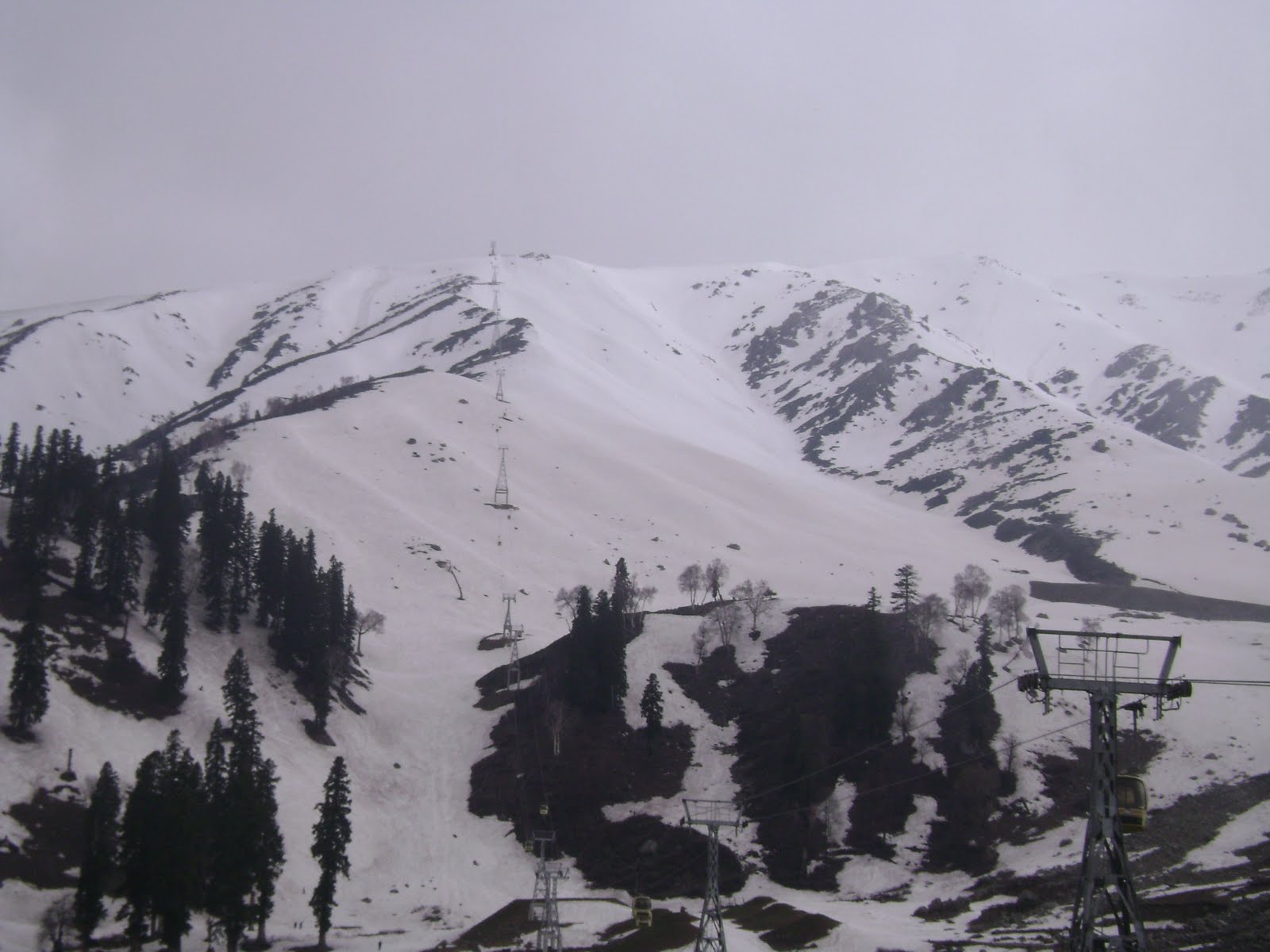 | ||||
| Cable car rides in Gulmarg subject to frequent power cuts. |
“They don’t want the people. They just want land”, he says referring to the games Pakistan is playing. He explains how the tourism industry died for many years, and people had to sell off ornaments to make a living. Things are looking better in the last 4 to 5 years, and the Kashmiris just want to keep it going that way without looking back. This is one possible reason why tips are relatively higher here than in other places.
Everyone must do themselves a favour and visit the Kashmir valley at some point of time. The place is way too rich to let it pass.
Mr. Billal organizes city tours and treks in and around Srinagar, and in the other parts of the region.
Subscribe to:
Posts (Atom)