It took three days of loneliness and solitude away from the madness of the city to bring me back to terms with what has been happening around me. We just inaugurated the largest nanofabrication research facility in India in the academic setting on the 5th of Jan 2011 at IISc Bangalore, and I’ve lost many nights of sleep in the walk up to it. But all-in-all it’s a proud moment for all of us involved in it, and certainly a landmark event that should set the pace for India’s foray into nano-scale R&D over the next decade.
I escaped to the some-what lonely beaches of Gokharna, a getaway in coastal Karnataka about 12 hours drive from the capital Bangalore. I spent the good part of my vacation lying in a hammock, drinking beer and reading Bill Bryson’s Notes from a Small Island. Short walks, morning pranayam and conversations with strangers happened too, though not necessarily in that order. And then I got back home, because I just couldn’t wait to show up at work on Monday morning. But this post (after a break of some 5 odd months; apologies (not like anyone cares)) comes on a totally unrelated subject, the signs for which have been jumping at me from all corners.
This one’s about… I don’t really have a smart phrase/word that will capture the whole idea, but let’s just say it’s about phrases/words that leave you a bit confused than you initially were. Let me take an example here to get started. I was traveling in a bus only recently, and you see these advertisement hoardings. I saw one, and for the life of me I can’t remember where this was, or what the ad was for. But I did take the catch line away with me and that’s enough fodder for my case. The line for this product read ‘Changing rules. Changing lives’. Right, I’m sure you’ve heard a similar version of that a zillion times before, as have I. But for kicks, and also because my i-pod had run out of battery and I wasn’t exactly sharing my seat with a pretty 20-something that I was sketching my opening lines, I began to replay what I had just read: Changing rules. Changing lives.
Let us take the first part i.e. ‘Changing rules’. What do these two words mean? Well, for one it could mean that the act of ‘changing’ (goodness knows what!) was one that commanded a superlative compliment- Changing rules! Like you would say Iron Maiden rules, or the sight from the mountain top rules, implying that there is no comparison, because the object in question is by far superior to anything else comparable to it. Hence, by that equation, changing rules. The other meaning is the obvious one implying the change of rules, like the change of weather, or a change of clothes. The third meaning of this phrase could be one to point the change of power or authority, as in the ‘the rule of such-and-such dynasty’. Therefore ‘Changing rules, changing lives’; well, not necessarily. You might think that I’m merely trying hard here to show you other cases similar to ‘time flies like an arrow’. Probably, yes!
Only this evening, I was driving down near Palace Grounds and like always they’ve got these exhibitions going. The organizers had a giant board put out at the entrance that announced ‘Old Hindi film songs and food mela’. Now you must help me here. Like many others, I have trouble using ‘and’ in its right place. But I spotted this one, aha! What was the mela about afterall? Take your pick:
a) Old Hindi film songs (cds, records whatever) + food (food in general)
b) Old Hindi film songs + Old Hindi film food (?)
c) Old Hindi film songs + Old Hindi food (?!)
d) Old Hindi film songs + Old food (doctor’s fee included in the entrance ticket).
I haven’t slept well last night in the bus from Gokharna to Bangalore. We had some gear box problems, and came to a halt in the middle of a forest. And somehow, just somehow, the driver managed to fix the issue temporarily till we got a mechanic to fix it for good at the nearest town 40 kilometers away. And that was at 3:30 a.m. So, I will have to end this here since my eyes are sagging like Preity Zinta’s face in the IPL auctions earlier today. But I will leave you with this thought, and I’ve said this earlier on Facebook as well: if 'thrifty' refers to someone who's diligent with the his/her money, how come 'spendthrift' means exactly the opposite?
Sunday, January 9, 2011


Tuesday, August 17, 2010
Constipated about reading magazines
I subscribe to two magazines at home: Forbes India and Reader’s Digest. I took up Forbes for a two year period because of the amazing introductory price that was offered. And with Reader’s Digest (RD); well, who wouldn’t want to read RD, even more with the way they keep turning out annoying ‘confirm your address for the luck draw’ mails in the post.
Forbes India shows up at my door step on the first and the third week of the month. RD shows up when ever it likes. For many years I was forced to read magazines that were ordered by the adults at home. Barring Tinkle and the occasional center page poster from Sportstar, there was little to choose from in terms of taste. There was always plenty of variety though: The Week, Outlook, Gruhashobha, Overdrive, Top Gear, Women’s Era, Competition Success and names like that. As age caught on and the teenage years kicked in, Tinkle and Sportstar were replaced by the auto-car reviews by Adil Jal Darukhanawala’s crew. And the distress columns in some other publications, but we won’t go there.
The longing was always to subscribe a magazine that I wanted, for subjects that I cared about and I paid for. Given my taste for things and my constant pursuit to up my IQ points a couple of notches, Forbes was an obvious choice. I was also told that people who appreciated jokes that made you tickle and longed to feel included in this world read RD. So, I couldn’t say no to that either. But little did I know then what I know now: that when one decides to start subscribing to the RD, the editors there sense it in the ether and start showing you ways of getting rich quick overnight in a lottery where every number wins.
I gobbled up every word of almost every article in the early editions. When the new editions arrived, I carefully took the expired one and placed it in the book rack and as the months rolled by, I ensured the chronological order was maintained. All this collective wisdom could just come in handy, you never know! I wasn’t the one to sell this off for its weight.
And then, marginal utility showed up. Like with all good things in life except one, this too came to end. I soon realized that I had stopped reading the editorials in either of the magazines. Soon after, articles on China and Health care were being skipped and the Word power column was for my one and half year old cousin sister. And then, it got to a stage where I read only what interested me in the publication, and most of them half way through. These are busy times, and the world knows it. Before I knew it, there were magazines that were untouched. The weeks would go, and the new edition would arrive. But the plastic cover had still not come off the previous edition. And I like reading my magazines in chronological order for I like to know the sequence of events. I learnt that a long while ago in school, the importance of chronology. They always taught us history before current affairs.
So with this obsession for reading magazines by their date of publication, I soon found myself in a position where I had magazines piling up and time slipping away. Soon my subscription period would end and they’d stop sending me the stuff. I began to feel obsolete as such; how sharp can I possibly be reading June’s news in July? This was like buying French Fries from McDonalds and taking it home to stuff it in the cupboard to eat it someday when you felt hungry. “What sense did that make?” I asked myself. It was me at the vortex and the magazines in a swivel. I had bitten off more than I could chew; chewed more than I could digest, and digested more than I could … you get the point.
I found a way out luckily. All the months of reading the magazines had rightly up’d my IQ a couple of notches. Instead of trying to read and assimilate everything from both the magazines, I now decided to focus on getting just one point out of each magazine. Any one good article that makes me laugh, or teaches me something useful and makes me wallow in misery is all I aim for. This ways there’s no pressure and my IQ continues its upward march. In 12 months, I would have 24 (Forbes) + 12 (RD) new ideas that worked/will work for me. Over a period of 5 years, that number would be 180. So if my projections are right, I’m well on course to winning the title of Global Leader of Tomorrow at the World Economic Forum in Davos by 2021, the Nobel Prize in Chemistry by 2030, and the Oscar the following year from then. Not to mention a couple of bravery awards between now and 2020.
My current challenge is to apply the same principle of ‘1 idea per magazine’ to the 2 newspapers that come to my house each day, and the hundred thousand online publications I read every hour.
Friday, August 6, 2010
The gap between good and bad
When I heard her say for the first time “what does ‘good’ and ‘bad’ mean? what is good and what is bad?”, I stared back with a blank expression not knowing how to handle a question like that. It seemed like a trick question for all I could see; one of those questions that breaks into a silence and anything the respondent says thereafter is either incorrect or incomplete. Luckily this time, it was a rhetorical one and the answer soon followed from her.
“Good and bad is what WE define: the society. But if you look at it, there is really no good and bad in this world. It’s about how we look at it.” I think she went on for the next ten minutes elaborating on this worldly issue of perceptions. I must have trashed it as pop-philosophy then, now that I come to think of it. But in keeping the subject of good and bad going, I see two cases that are clearly presented to my mind where one could put the two words into context in a way that it has a fair deal of meaning. One is of ‘intentions and actions’ and the other being ‘subject and environment’.
Intentions and Actions
I’m currently involved in a project wherein we’re putting together the largest Clean-room in an academic institution in the country. While the construction is happening, the designs for the subsystems (like water supply, fire suppressants and so on) undergo continuous changes and is a work-in-progress, as you would know if you were an architect, a civil engineer, or simply knew the ways of the business. In one of our weekly reviews with the contractor, we were just not pleased with the fact that he had deviated from the frozen design, albeit a small one, without prior notice. This argument started, went back and forth, and finally settled. At the end, the contractor said in his defense “We only have good intentions for you”.
He had hardly finished the line, and a professor who was part of the design team flew at him. “Haven’t you heard my favourite saying?” he asked.
“The road to hell is paved with good intentions.”
I guess the penny dropped for the contractor, and a prolonged silence implied he had got the point.
Why does this happen all the time? For long, I maintained that my Uncle held the copyrights to the line “I’ve always had good intentions.” Though I never brought it up with him, I often wondered if that were to be true, why are the actions not in line with ‘good intentions’?
Which do I more trust in and buy into- the good intentions or the bad actions? Some would call it ‘walking the talk’, but call it what you will, it’s a gap in what we wish to do and what we do that baffles others, but rarely bothers us! Ask any child whose parent declared they loved the child and yet somebody went home in the evening after school having to lie about their test grades for a variety of reasons that are irrelevant to this theme.
Subject and Environment
There’s the story of the famous violinist Joshua Bell who stood on a busy street in Washington D.C at peak hour in the day playing on his $ 3 million violin. In their haste to get to work, hardly any one took notice, and by the end of 45 minutes of playing, all he could show was about 32 dollars in collections in his hat that was laid out. Just a couple of weeks earlier, he had played to a packed audience of a few thousands at a landmark auditorium in the same city.
Environment makes the man. This idea is as old as the hills. But when you think about it, environment really makes the man; or the woman. A friend and I recently co-authored an article for a college magazine. When we got the prints in our hands, we were disappointed to see the article aligned and typeset very poorly.
“It makes us looks like bad writers”, my co-author remarked and I couldn’t disagree with him.
There are several cases like this where a good subject stuck in a bad environment ends up being perceived by the outside as bad. A good student in the midst of teachers who can’t rise beyond their petty selves, a good athlete and a poor coach, a genuinely good stand up comedian (or a musician) playing to the wrong audience all end up looking not quite like what they should.
The natural order of arrangement implies that a sharp looking person, well dressed, would be taken more seriously by a stranger in an air-conditioned conference room, or a social setting of some standard, than in a flea market by the heat of the day.
There’s always a best fit for everything. When there’s a sizable gap between the quality of the subject and the quality of the environment and an optimal fit doesn’t occur, it’s best for the subject to look elsewhere for a place or a way to work things out where it feels easier and more natural. Until then, he’ll continue brushing his teeth with his left hand.
Monday, August 2, 2010
The plan was to meet at Mandarin at 7 for dinner
The plan was to meet at Mandarin at 7 for dinner. I was told this place was at the intersection of Double Road CMH Road Double Road
I recently made a list of things I hate. At the very top was ‘wax matches’ followed by ‘the sight of food after a heavy meal’. Lower down the order were ‘pants that are shorter by an inch’, ‘travel plans getting cancelled’ and ‘the political situation in North Korea Bangalore
I was determined to ride the bus, even if that meant I’d be an hour late. I visualized it in my head. My friend would text me saying ‘where r u’. I’d say ‘reaching in 10 mins’. Twenty minutes later I’d send another text saying ‘stuck in traffic, be there soon’. And I ride the bus for 12 kilometers for the next hour through the traffic free roads of the city on a Sunday evening. I must have been but 200 meters from the bus stop when I noticed an auto parked by the side of the road playing the song Pehli baar miley hain from the movie Saajan. Goodness! It’d been donkey’s years since I last heard that song. I slowed my paces as I walked past the auto just to take in more of the song. And just I did that, I noticed the auto was empty. There were no passengers or the driver, but the song was playing aloud. I stood there listening to it. What the heck, I thought.
The driver, who had been answering nature’s call not too far from the auto stood, came to where I was. He must have assumed I was waiting to hire the auto. But phew, like, “Yea right! An auto is what I need”, I almost said to myself. I was just there for a few more seconds of the song. By now, I was six years old once more, teleported into the 90’s and slyly grinning as I stood there listening to the track completely lost.
“Indiranagar barthira ? (Will you come to Indiranagar?)” I asked him. What was going on! This was the enemy. I shouldn’t be saying this stuff.
"Indiranagar alli yelli? (Where in Indiranagar?)”, I heard him say so feebly, with his voice drowning in the tunes of SPB’s jingle.
I followed in to the comfortable backseat still humming along to the tune. Once inside, I turned around and noticed these huge speakers blaring beside me. No complaints, I assured myself as he got started and the meter was turned on.
In minutes, he flipped a switch and a bright set of overhead LEDs came on. All colours: yellow, green, purple, red were flickering at regular intervals like disco lights in the auto. Slowly, he kicked up the volume as the auto gathered speed. I felt like the kid in the candy store spoiled for choice. Here were lights, music, and an auto driver at the helm of things who knew the shortest route, and drove fast but not reckless. I took an occasional look at the meter. Whoo hoo! I wasn’t being cheated. I could just as well have been in a 2010 Chritopher Nolan movie.
This is where I switch to present tense.
The track ends. In the silence before the next song on the CD starts, I ask him if he can repeat the one that just finished. He repeats the track. No questions asked. This is surely a DJ who drives an auto because no disco or pub would hire him. Idiots, serves them all right for overlooking this piece of talent. We stop at a signal. I look at the vehicles parked around us. There’s an auto on the left. The driver in it is sheepishly checking out the cool interiors of my auto. The passenger in it is a fat bald dude wearing lungi carrying several tiffin dabbas. Poor folks have no LED shows, no music and I’m sure the meter in that auto is rigged. I see to the right: a BMW 5 series with its windows rolled up. Rich farts and losers who can’t appreciate fresh air of the evening. To the front is a bike, and I can only see the waistline of the chik who is sitting on it. Bah! While I’m not complaining, I try estimating how uncomfortable that bike must feel what with it not having comfortable cushioned seats like my auto.
The signal is green, and off we go. It’s now Tu shaayar hai. This can’t be for real, I think. The songs are getting better. And the track changes before I wipe my smile off.
Dhekha hey pehli baar … feels like an overdose of sugar that leaves your mouth tasting bitter.
And before I know it, we’ve arrived in front of Mandarin. He turns off the auto and the music shuts off with it. I want to tell him, “Screw the dinner, can we continue riding?”
But I get off and pay him. I take two steps from the auto feeling sad. Very sad. I turn around and walk back to him.
“This is the best auto ride of my life.” My voice shakes as it come out. “Keep going this way.”
I note the auto number and walk up the stairs to catch fried noodles and schezwan rice for dinner. It’s two minutes to seven.
Sunday, August 1, 2010
Srinagar
I wrote this account based on my trip to the Kashmir valley in April 2010, before recent violence broke out.
-------
Our cabbie reckons we ought to visit Chashmashahi, the Mughal Garden. We walk up the steep flight of stairs to be greeted by a pleasant view of lush greenery of the hills, the well manicured lawns and a flowing stream of water. Kids here speak the language they grew up hearing; we chance up on two young boys splashing water at each other near the fountain. One is saying to the other “Hamare beech mein abhi encounter hoga.” (There’s going to be an encounter between us now).
From the minute you land in Srinagar, capital of the picturesque Kashmir valley, you smell hope all around. The people here are clearly waking up to life after spending years in fear and only a dead-end in sight. The roads are well kept, life moves at the pace of any large town and the place in inundated with ad-boards of mobile phone service providers and private airlines announcing connectivity to all the major cities in the country. Security forces like the CRPF, State Police, and the Army are stationed at every second turning on the road. But we are assured by Mr. Billal, our guide, that this place is safe. Our home for the next couple of days is going to be on a boat-house in Dal Lake. The lake in its sheer existence is a microcosm in itself. Kids are born, families are raised and entire life times are spent on Dal Lake for thousands of people. There are close to two-thousand house boats in the lake, many of which are lodging facilities for tourists. They usually have well decorated interiors, and complete with all amenities. Shikaras ferry you back and forth to land. One can see floating markets, flower shops, and photographers all over the place.
Billal talks about places like Kargil and Drass in the same breath as someone living in Bangalore would say of Mysore. “It’s just a drive down”, you know what I mean. In the late nineties, these places were battlefields that made the country hold on to its breath and pray for the safe return of its soldiers. Today, the situation is a bit different. You can hop into a car and drive the distance to Kargil, en route to Leh from Srinagar. As Billai explains, Kargil is also the focal point for some of the best treks in the region, the Zanskar route being the most popular. As it turns out, it takes a 15 member back up crew providing supplies for a 2 member trek party on the 3 weeks Zanskar trek through the Karakoram Range.
We spend a day in the beautiful hill station of Gulmarg. You get around the place on mules that can be extremely annoying and the rides are grossly over-priced. But there’s really no other choice. Army trucks keep whizzing past our car on the way back from Gulmarg to Srinagar. As you re-enter the city, you can see posters of Mahmoud Ahmadinejad, the current president of Iran. Our driver is vary to take us close to Lal Chowk, the central part of town where the Secretariat is housed. Most violence in the city usually breaks out here, and hence news channels have their vans stationed at the square all the time.
Back in the comfort of out boat-house, I get talking to Billal over a cup of khava, the traditional Kashmiri tea. Here’s a well traveled guy with good knowledge of the history, geography and politics of the place. Azad Kashmir (or POK) and the Kasmir valley on the Indian side are the same in terms of the composition of the people, their tastes and lifestyles. “It’s just like East and West Germany; or North and South Korea”, he explains. There are families separated by the border hoping to reach out and reunite someday.”
“They don’t want the people. They just want land”, he says referring to the games Pakistan is playing. He explains how the tourism industry died for many years, and people had to sell off ornaments to make a living. Things are looking better in the last 4 to 5 years, and the Kashmiris just want to keep it going that way without looking back. This is one possible reason why tips are relatively higher here than in other places.
Everyone must do themselves a favour and visit the Kashmir valley at some point of time. The place is way too rich to let it pass.
Mr. Billal organizes city tours and treks in and around Srinagar, and in the other parts of the region.
-------
Our cabbie reckons we ought to visit Chashmashahi, the Mughal Garden. We walk up the steep flight of stairs to be greeted by a pleasant view of lush greenery of the hills, the well manicured lawns and a flowing stream of water. Kids here speak the language they grew up hearing; we chance up on two young boys splashing water at each other near the fountain. One is saying to the other “Hamare beech mein abhi encounter hoga.” (There’s going to be an encounter between us now).
 |
| A Shikara in Dal Lake. |
Billal talks about places like Kargil and Drass in the same breath as someone living in Bangalore would say of Mysore. “It’s just a drive down”, you know what I mean. In the late nineties, these places were battlefields that made the country hold on to its breath and pray for the safe return of its soldiers. Today, the situation is a bit different. You can hop into a car and drive the distance to Kargil, en route to Leh from Srinagar. As Billai explains, Kargil is also the focal point for some of the best treks in the region, the Zanskar route being the most popular. As it turns out, it takes a 15 member back up crew providing supplies for a 2 member trek party on the 3 weeks Zanskar trek through the Karakoram Range.
We spend a day in the beautiful hill station of Gulmarg. You get around the place on mules that can be extremely annoying and the rides are grossly over-priced. But there’s really no other choice. Army trucks keep whizzing past our car on the way back from Gulmarg to Srinagar. As you re-enter the city, you can see posters of Mahmoud Ahmadinejad, the current president of Iran. Our driver is vary to take us close to Lal Chowk, the central part of town where the Secretariat is housed. Most violence in the city usually breaks out here, and hence news channels have their vans stationed at the square all the time.
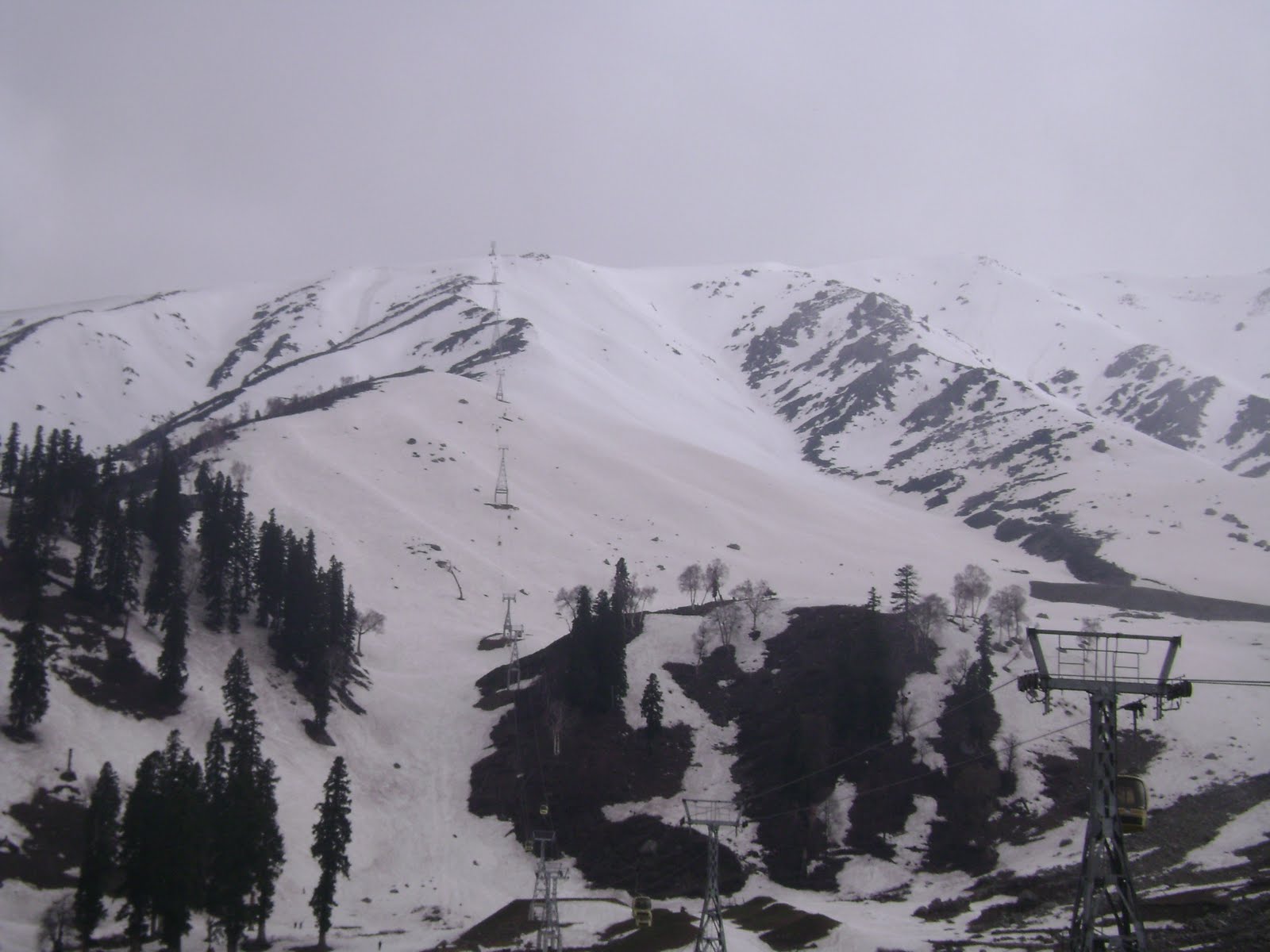 | ||||
| Cable car rides in Gulmarg subject to frequent power cuts. |
“They don’t want the people. They just want land”, he says referring to the games Pakistan is playing. He explains how the tourism industry died for many years, and people had to sell off ornaments to make a living. Things are looking better in the last 4 to 5 years, and the Kashmiris just want to keep it going that way without looking back. This is one possible reason why tips are relatively higher here than in other places.
Everyone must do themselves a favour and visit the Kashmir valley at some point of time. The place is way too rich to let it pass.
Mr. Billal organizes city tours and treks in and around Srinagar, and in the other parts of the region.
Sunday, March 28, 2010
Keep your gift and let me home
For several years, we lived next door to a family that owned close to 20 cows. The main source of income for the household came from the milk they sold to people in the neighborhood. They had all kinds of cows – desi ones, big ones, small calves, two headed cows, and there was even one from Germany that flew into Bangalore in 1994 for a princely sum of Rs 45,000. It gave so much milk; the other cows developed a complex after a while. They made wonderful neighbors, and were the typical courteous family that you like to have around. They bought sweets on festivals, and their kids were taught to share crackers with me during Diwali. They had many kids running around the house, for there’s had been a joint establishment.
Anytime you have kids around at home, it’s a co-incidence that you have birthdays to celebrate. And anytime there are birthdays to celebrate, there are other kids to be invited. And anytime kids are invited, parents send their tots with a nicely wrapped gift to be handed over. My aunt was visiting us one evening, and as it turned out it was also one my neighbor’s kid’s birthday. I got the invite to attend the celebration just an hour prior to the actual candle blowing ceremony. And boy was I excited!
There was one issue, however. It was too late to go out and buy presents that I could take. So, my Aunt suggested that I should dig into my own unused stationery stock, make a nice little packet out of it and take it for the kid who was turning 5 or something. Probably re-gifting is not quite the norm with people in their 20s today, but ask anyone 45 or more, and they don’t seem to think it’s bizarre at all. I must have taken with me to the birthday party an imported pencil, a foreign eraser shaped like a light bulb, a stationery box and few more odds and ends as the present.
After the cake was cut and the fun was had, I gifted the little boy what I had got for him. He opened it right in front of me, with his mother standing there looking on. They must have expected to find something outrageous, I guess. But when the kid opened and found some cool looking stationery in it, he was happy. I think you could upgrade that to ‘ecstatic’. His mother assumed I was more grown-up in the head than I actually was, and so she tested me with the line “Oh, why did you bring all this expensive stuff?”
This was my moment to be the big man. It had finally arrived. Without as much as batting an eyelid, I said, “Not a problem, Aunty. All this stuff was at home, and so I decided to get it. No trouble at all.”
I learnt my lesson with gifts that day. I understood that you can never gift that ‘perfect gift’ to anyone. You just can’t. Maybe it’ll be too big for them, maybe it’s too small, maybe it’s the wrong time, maybe they’ll think you’re plain cheap; or maybe, they’ll think you’re just showing off. But whatever it is, they’ll never suspect that you’re re-gifting it. I’m convinced about it. When I get a gift, I might think what a cheapskate the person is, but I would never be inclined to think that he or she is just re-gifting the stuff. That would be the last thought in my head. Maybe this person would re-gift their things to others, but come on; to me? No way.
Then somebody came up with the idea of gift coupons. I once got gifted a voucher for five hundred bucks at a music store. I thought to myself, “The world needs more people like her. By giving me this coupon she’s telling a couple of things at the same time. One, she’s saying, here’s my budget for you. Now go do what you want with it. Two, I don’t really want to waste my time thinking about what you might like, or ask my friends what his tastes are. So three, here’s the money; you go do the shopping for yourself.” I loved this idea. I mean thank goodness I got a gift coupon from this person. What if she had given me something scary instead? Maybe like a horror movie DVD or something. Yuck, I don’t even watch horror stuff.
So off I went to music store and bought a couple of Steven Segal movies, Dirty Dancing and one or two other DVDs. When I looked at the bill total, it was fifty bucks more than the coupon amount of five hundred. I had two choices here: pay the extra fifty or keep back one of the DVDs. I thought about it for a while. Paying the extra money just didn’t seem right. It was a gift after all, and no one pays for a gift. But option two pissed me off even more. By keeping back one of the DVDs, the shop got to keep 50 bucks with them, because the total was now 450. That just didn’t seem fair. So I sprayed chilly powder into the cashier’s eyes and ran out of the door with all the DVDs. “Take that, you suckers.” I said to myself as I ran down the walkway to the store.
Gift coupons in stores are like the casino. The house always wins.
Monday, March 22, 2010
Through the lookers’ eyes: 5 societal trends that IPL ads want us to know
This IPL has been an ad fest. All this while, ads were shown only between overs, drinks breaks and when wickets fell. This time, they’re playing them in between deliveries (took a great deal of self control to refrain from using the word balls); and not just as the fast bowler walks back to take his run-up, even the spinners are not spared. So for the viewers, it’s not just the flurry of ads that is irksome, it’s the fact that most of these ads are pathetic means that one needs a greater degree of tolerance to put up with them. Watch the Tata Docomo ad, where the guy dumps his girlfriend and walks out with this other chik, if you aren’t convinced. Here’s an open appeal to Mr. Ratan Tata to fire the ad agency, and the VP of marketing of Tata Docomo. Shoddy stuff. The Zoozoo ads too are average at best.
But like Sherlock says in the movie, one can still make order out of chaos. I’ve tried to capture some of the emerging trends in the market place that advertisers are seeing this IPL time and playing to the tunes accordingly.
1) A bit of Tiger for everyone: Aircel started the ‘There are only 1411 left’ campaign, and several folks are now jumping on this boat. A couple of the Vodafone’s zoozoo ads feature the zoozoos’ accidental misadventures with the wild cat. Though not directly featuring the tiger, one of Airtel’s direct cable connection ads shows a cheetah running across and encourages people to watch wild life shows on TV.
2) Nimboo pani: Summer is about to set in, and it’s time for the soft drink makers to up the campaigns. But there are visibly three companies pitching for consumers to drink lemon flavored soft drinks. My guess is that lemon drinks don’t enjoy a high market share in India. And with the colas coming under fire every now and then, companies are looking to back themselves up by creating a larger market for nimbu paani. Minute Maid, Nimbuuuz and 7UP Lemon are at it, with the first two showcasing their product as being no different from freshly cut lime mixed in water.
3) AC for India: Keeping with the theme of summer, this is the perfect time for fan and air conditioner companies to get to work. Havells is excited like never before about its fans and safe-switches for hand held air dryers. But what interested me more were the air-conditioners. Amongst others, Samsung, Voltas and Godrej have been repetitively screening their ads with a heavy emphasis on the fact that their ACs are ‘made for India’. The reason ACs haven’t penetrated household markets in India is primarily due to the fear people have of a high electricity bill that might result therefore. So most people who would like to have an AC at home never buy one due to this fear. If you look at these three ads again, it’s not surprising to find that the central idea is that of ACs that consume less power.
4) Mobile phones for rural markets: It was only after reading a story in last month’s edition of Forbes could I understand the cause for the sudden influx of small time mobile phone makers challenging the Nokias, Sonys and Samsungs. Have you ever stopped and wondered the same thing? Until a few months back who had even heard of mobile phones from Micromax, Maxx, Lemon, Lava, Inq, Spice and Videocon? As much as we see mobile communication all around us, a great part of the rural market still remains untouched. The same is true for dual-sim mobiles for urban crowds. My guess is that most of these new players want a share of both these pies. This has really woken up the established players to start looking at their options. Understand the Samsung Guru mobile ad featuring Aamir Khan from this perspective, and it should make sense.
5) Gojiyo.com: A last observation is the launch of Godrej’s virtual reality portal gojiyo.com. The advertisement displays two subtle yet remarkable trends in the economy. Number one, the Indian youth is ready to accept or at least try a hand at virtual reality; something that Second Life despite all its success in the west could not make a dent in the Indian market. A name like Second Life is very niche, compared to a more mass appealing name like gojiyo. The second observation, in my opinion is to be considered with more weight than the first. It basically says that you still need to advertise a website on television. Since the internet penetration in India in still low, companies still need to go to the television crowds to preview a teaser of their websites. This shouldn’t really come as a surprise if you also observed that the number of ads for television sets is noticeably high this IPL.
This article is not an ad feature, and opinions mentioned here are solely mine. Brand names have been taken out of free-will, and I have kept away from providing back-links to any of them.
If you liked this article, you might also want to read this.
Subscribe to:
Posts (Atom)