When I heard her say for the first time “what does ‘good’ and ‘bad’ mean? what is good and what is bad?”, I stared back with a blank expression not knowing how to handle a question like that. It seemed like a trick question for all I could see; one of those questions that breaks into a silence and anything the respondent says thereafter is either incorrect or incomplete. Luckily this time, it was a rhetorical one and the answer soon followed from her.
“Good and bad is what WE define: the society. But if you look at it, there is really no good and bad in this world. It’s about how we look at it.” I think she went on for the next ten minutes elaborating on this worldly issue of perceptions. I must have trashed it as pop-philosophy then, now that I come to think of it. But in keeping the subject of good and bad going, I see two cases that are clearly presented to my mind where one could put the two words into context in a way that it has a fair deal of meaning. One is of ‘intentions and actions’ and the other being ‘subject and environment’.
Intentions and Actions
I’m currently involved in a project wherein we’re putting together the largest Clean-room in an academic institution in the country. While the construction is happening, the designs for the subsystems (like water supply, fire suppressants and so on) undergo continuous changes and is a work-in-progress, as you would know if you were an architect, a civil engineer, or simply knew the ways of the business. In one of our weekly reviews with the contractor, we were just not pleased with the fact that he had deviated from the frozen design, albeit a small one, without prior notice. This argument started, went back and forth, and finally settled. At the end, the contractor said in his defense “We only have good intentions for you”.
He had hardly finished the line, and a professor who was part of the design team flew at him. “Haven’t you heard my favourite saying?” he asked.
“The road to hell is paved with good intentions.”
I guess the penny dropped for the contractor, and a prolonged silence implied he had got the point.
Why does this happen all the time? For long, I maintained that my Uncle held the copyrights to the line “I’ve always had good intentions.” Though I never brought it up with him, I often wondered if that were to be true, why are the actions not in line with ‘good intentions’?
Which do I more trust in and buy into- the good intentions or the bad actions? Some would call it ‘walking the talk’, but call it what you will, it’s a gap in what we wish to do and what we do that baffles others, but rarely bothers us! Ask any child whose parent declared they loved the child and yet somebody went home in the evening after school having to lie about their test grades for a variety of reasons that are irrelevant to this theme.
Subject and Environment
There’s the story of the famous violinist Joshua Bell who stood on a busy street in Washington D.C at peak hour in the day playing on his $ 3 million violin. In their haste to get to work, hardly any one took notice, and by the end of 45 minutes of playing, all he could show was about 32 dollars in collections in his hat that was laid out. Just a couple of weeks earlier, he had played to a packed audience of a few thousands at a landmark auditorium in the same city.
Environment makes the man. This idea is as old as the hills. But when you think about it, environment really makes the man; or the woman. A friend and I recently co-authored an article for a college magazine. When we got the prints in our hands, we were disappointed to see the article aligned and typeset very poorly.
“It makes us looks like bad writers”, my co-author remarked and I couldn’t disagree with him.
There are several cases like this where a good subject stuck in a bad environment ends up being perceived by the outside as bad. A good student in the midst of teachers who can’t rise beyond their petty selves, a good athlete and a poor coach, a genuinely good stand up comedian (or a musician) playing to the wrong audience all end up looking not quite like what they should.
The natural order of arrangement implies that a sharp looking person, well dressed, would be taken more seriously by a stranger in an air-conditioned conference room, or a social setting of some standard, than in a flea market by the heat of the day.
There’s always a best fit for everything. When there’s a sizable gap between the quality of the subject and the quality of the environment and an optimal fit doesn’t occur, it’s best for the subject to look elsewhere for a place or a way to work things out where it feels easier and more natural. Until then, he’ll continue brushing his teeth with his left hand.
Friday, August 6, 2010


Monday, August 2, 2010
The plan was to meet at Mandarin at 7 for dinner
The plan was to meet at Mandarin at 7 for dinner. I was told this place was at the intersection of Double Road CMH Road Double Road
I recently made a list of things I hate. At the very top was ‘wax matches’ followed by ‘the sight of food after a heavy meal’. Lower down the order were ‘pants that are shorter by an inch’, ‘travel plans getting cancelled’ and ‘the political situation in North Korea Bangalore
I was determined to ride the bus, even if that meant I’d be an hour late. I visualized it in my head. My friend would text me saying ‘where r u’. I’d say ‘reaching in 10 mins’. Twenty minutes later I’d send another text saying ‘stuck in traffic, be there soon’. And I ride the bus for 12 kilometers for the next hour through the traffic free roads of the city on a Sunday evening. I must have been but 200 meters from the bus stop when I noticed an auto parked by the side of the road playing the song Pehli baar miley hain from the movie Saajan. Goodness! It’d been donkey’s years since I last heard that song. I slowed my paces as I walked past the auto just to take in more of the song. And just I did that, I noticed the auto was empty. There were no passengers or the driver, but the song was playing aloud. I stood there listening to it. What the heck, I thought.
The driver, who had been answering nature’s call not too far from the auto stood, came to where I was. He must have assumed I was waiting to hire the auto. But phew, like, “Yea right! An auto is what I need”, I almost said to myself. I was just there for a few more seconds of the song. By now, I was six years old once more, teleported into the 90’s and slyly grinning as I stood there listening to the track completely lost.
“Indiranagar barthira ? (Will you come to Indiranagar?)” I asked him. What was going on! This was the enemy. I shouldn’t be saying this stuff.
"Indiranagar alli yelli? (Where in Indiranagar?)”, I heard him say so feebly, with his voice drowning in the tunes of SPB’s jingle.
I followed in to the comfortable backseat still humming along to the tune. Once inside, I turned around and noticed these huge speakers blaring beside me. No complaints, I assured myself as he got started and the meter was turned on.
In minutes, he flipped a switch and a bright set of overhead LEDs came on. All colours: yellow, green, purple, red were flickering at regular intervals like disco lights in the auto. Slowly, he kicked up the volume as the auto gathered speed. I felt like the kid in the candy store spoiled for choice. Here were lights, music, and an auto driver at the helm of things who knew the shortest route, and drove fast but not reckless. I took an occasional look at the meter. Whoo hoo! I wasn’t being cheated. I could just as well have been in a 2010 Chritopher Nolan movie.
This is where I switch to present tense.
The track ends. In the silence before the next song on the CD starts, I ask him if he can repeat the one that just finished. He repeats the track. No questions asked. This is surely a DJ who drives an auto because no disco or pub would hire him. Idiots, serves them all right for overlooking this piece of talent. We stop at a signal. I look at the vehicles parked around us. There’s an auto on the left. The driver in it is sheepishly checking out the cool interiors of my auto. The passenger in it is a fat bald dude wearing lungi carrying several tiffin dabbas. Poor folks have no LED shows, no music and I’m sure the meter in that auto is rigged. I see to the right: a BMW 5 series with its windows rolled up. Rich farts and losers who can’t appreciate fresh air of the evening. To the front is a bike, and I can only see the waistline of the chik who is sitting on it. Bah! While I’m not complaining, I try estimating how uncomfortable that bike must feel what with it not having comfortable cushioned seats like my auto.
The signal is green, and off we go. It’s now Tu shaayar hai. This can’t be for real, I think. The songs are getting better. And the track changes before I wipe my smile off.
Dhekha hey pehli baar … feels like an overdose of sugar that leaves your mouth tasting bitter.
And before I know it, we’ve arrived in front of Mandarin. He turns off the auto and the music shuts off with it. I want to tell him, “Screw the dinner, can we continue riding?”
But I get off and pay him. I take two steps from the auto feeling sad. Very sad. I turn around and walk back to him.
“This is the best auto ride of my life.” My voice shakes as it come out. “Keep going this way.”
I note the auto number and walk up the stairs to catch fried noodles and schezwan rice for dinner. It’s two minutes to seven.
Sunday, August 1, 2010
Srinagar
I wrote this account based on my trip to the Kashmir valley in April 2010, before recent violence broke out.
-------
Our cabbie reckons we ought to visit Chashmashahi, the Mughal Garden. We walk up the steep flight of stairs to be greeted by a pleasant view of lush greenery of the hills, the well manicured lawns and a flowing stream of water. Kids here speak the language they grew up hearing; we chance up on two young boys splashing water at each other near the fountain. One is saying to the other “Hamare beech mein abhi encounter hoga.” (There’s going to be an encounter between us now).
From the minute you land in Srinagar, capital of the picturesque Kashmir valley, you smell hope all around. The people here are clearly waking up to life after spending years in fear and only a dead-end in sight. The roads are well kept, life moves at the pace of any large town and the place in inundated with ad-boards of mobile phone service providers and private airlines announcing connectivity to all the major cities in the country. Security forces like the CRPF, State Police, and the Army are stationed at every second turning on the road. But we are assured by Mr. Billal, our guide, that this place is safe. Our home for the next couple of days is going to be on a boat-house in Dal Lake. The lake in its sheer existence is a microcosm in itself. Kids are born, families are raised and entire life times are spent on Dal Lake for thousands of people. There are close to two-thousand house boats in the lake, many of which are lodging facilities for tourists. They usually have well decorated interiors, and complete with all amenities. Shikaras ferry you back and forth to land. One can see floating markets, flower shops, and photographers all over the place.
Billal talks about places like Kargil and Drass in the same breath as someone living in Bangalore would say of Mysore. “It’s just a drive down”, you know what I mean. In the late nineties, these places were battlefields that made the country hold on to its breath and pray for the safe return of its soldiers. Today, the situation is a bit different. You can hop into a car and drive the distance to Kargil, en route to Leh from Srinagar. As Billai explains, Kargil is also the focal point for some of the best treks in the region, the Zanskar route being the most popular. As it turns out, it takes a 15 member back up crew providing supplies for a 2 member trek party on the 3 weeks Zanskar trek through the Karakoram Range.
We spend a day in the beautiful hill station of Gulmarg. You get around the place on mules that can be extremely annoying and the rides are grossly over-priced. But there’s really no other choice. Army trucks keep whizzing past our car on the way back from Gulmarg to Srinagar. As you re-enter the city, you can see posters of Mahmoud Ahmadinejad, the current president of Iran. Our driver is vary to take us close to Lal Chowk, the central part of town where the Secretariat is housed. Most violence in the city usually breaks out here, and hence news channels have their vans stationed at the square all the time.
Back in the comfort of out boat-house, I get talking to Billal over a cup of khava, the traditional Kashmiri tea. Here’s a well traveled guy with good knowledge of the history, geography and politics of the place. Azad Kashmir (or POK) and the Kasmir valley on the Indian side are the same in terms of the composition of the people, their tastes and lifestyles. “It’s just like East and West Germany; or North and South Korea”, he explains. There are families separated by the border hoping to reach out and reunite someday.”
“They don’t want the people. They just want land”, he says referring to the games Pakistan is playing. He explains how the tourism industry died for many years, and people had to sell off ornaments to make a living. Things are looking better in the last 4 to 5 years, and the Kashmiris just want to keep it going that way without looking back. This is one possible reason why tips are relatively higher here than in other places.
Everyone must do themselves a favour and visit the Kashmir valley at some point of time. The place is way too rich to let it pass.
Mr. Billal organizes city tours and treks in and around Srinagar, and in the other parts of the region.
-------
Our cabbie reckons we ought to visit Chashmashahi, the Mughal Garden. We walk up the steep flight of stairs to be greeted by a pleasant view of lush greenery of the hills, the well manicured lawns and a flowing stream of water. Kids here speak the language they grew up hearing; we chance up on two young boys splashing water at each other near the fountain. One is saying to the other “Hamare beech mein abhi encounter hoga.” (There’s going to be an encounter between us now).
 |
| A Shikara in Dal Lake. |
Billal talks about places like Kargil and Drass in the same breath as someone living in Bangalore would say of Mysore. “It’s just a drive down”, you know what I mean. In the late nineties, these places were battlefields that made the country hold on to its breath and pray for the safe return of its soldiers. Today, the situation is a bit different. You can hop into a car and drive the distance to Kargil, en route to Leh from Srinagar. As Billai explains, Kargil is also the focal point for some of the best treks in the region, the Zanskar route being the most popular. As it turns out, it takes a 15 member back up crew providing supplies for a 2 member trek party on the 3 weeks Zanskar trek through the Karakoram Range.
We spend a day in the beautiful hill station of Gulmarg. You get around the place on mules that can be extremely annoying and the rides are grossly over-priced. But there’s really no other choice. Army trucks keep whizzing past our car on the way back from Gulmarg to Srinagar. As you re-enter the city, you can see posters of Mahmoud Ahmadinejad, the current president of Iran. Our driver is vary to take us close to Lal Chowk, the central part of town where the Secretariat is housed. Most violence in the city usually breaks out here, and hence news channels have their vans stationed at the square all the time.
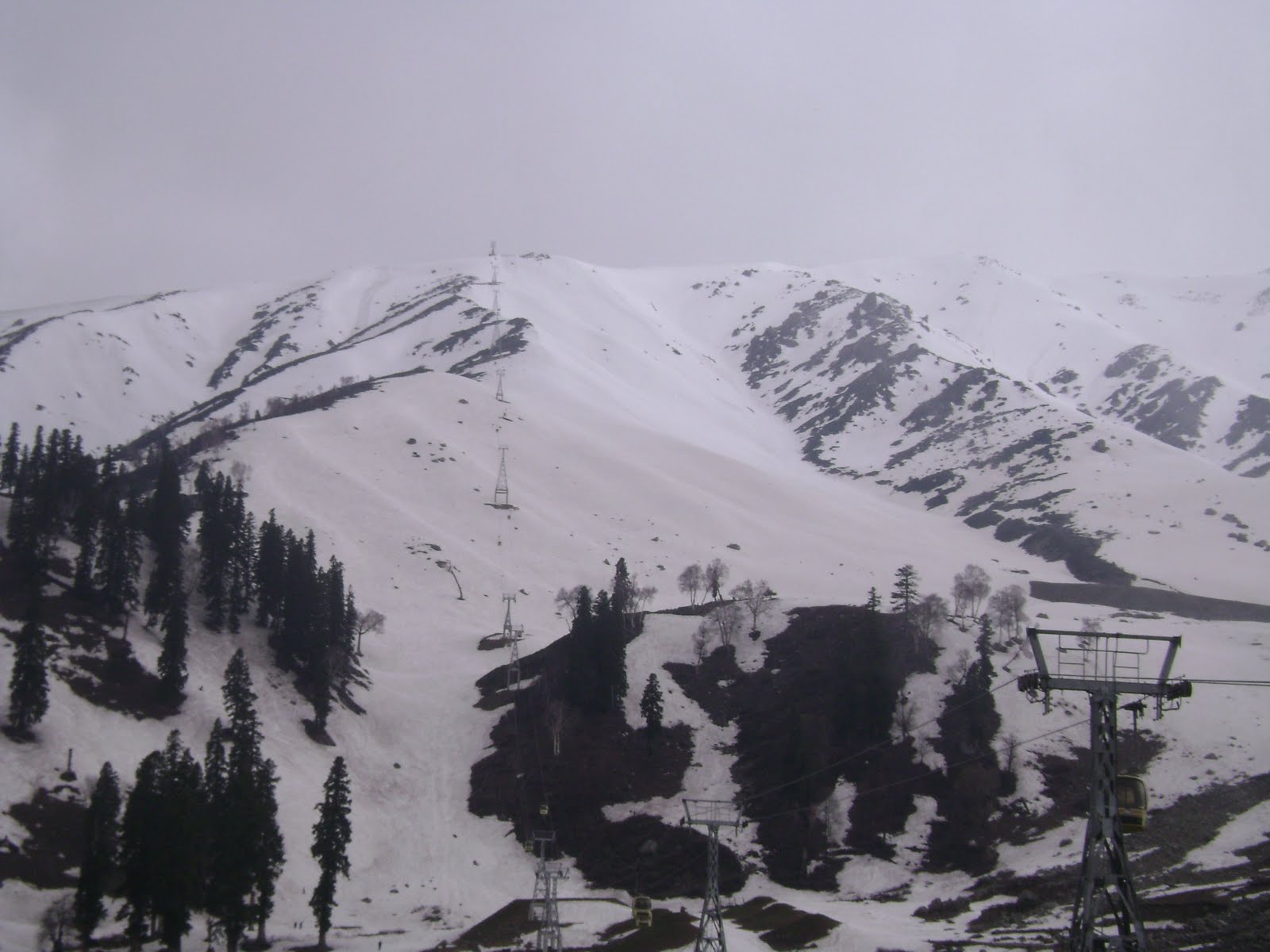 | ||||
| Cable car rides in Gulmarg subject to frequent power cuts. |
“They don’t want the people. They just want land”, he says referring to the games Pakistan is playing. He explains how the tourism industry died for many years, and people had to sell off ornaments to make a living. Things are looking better in the last 4 to 5 years, and the Kashmiris just want to keep it going that way without looking back. This is one possible reason why tips are relatively higher here than in other places.
Everyone must do themselves a favour and visit the Kashmir valley at some point of time. The place is way too rich to let it pass.
Mr. Billal organizes city tours and treks in and around Srinagar, and in the other parts of the region.
Sunday, March 28, 2010
Keep your gift and let me home
For several years, we lived next door to a family that owned close to 20 cows. The main source of income for the household came from the milk they sold to people in the neighborhood. They had all kinds of cows – desi ones, big ones, small calves, two headed cows, and there was even one from Germany that flew into Bangalore in 1994 for a princely sum of Rs 45,000. It gave so much milk; the other cows developed a complex after a while. They made wonderful neighbors, and were the typical courteous family that you like to have around. They bought sweets on festivals, and their kids were taught to share crackers with me during Diwali. They had many kids running around the house, for there’s had been a joint establishment.
Anytime you have kids around at home, it’s a co-incidence that you have birthdays to celebrate. And anytime there are birthdays to celebrate, there are other kids to be invited. And anytime kids are invited, parents send their tots with a nicely wrapped gift to be handed over. My aunt was visiting us one evening, and as it turned out it was also one my neighbor’s kid’s birthday. I got the invite to attend the celebration just an hour prior to the actual candle blowing ceremony. And boy was I excited!
There was one issue, however. It was too late to go out and buy presents that I could take. So, my Aunt suggested that I should dig into my own unused stationery stock, make a nice little packet out of it and take it for the kid who was turning 5 or something. Probably re-gifting is not quite the norm with people in their 20s today, but ask anyone 45 or more, and they don’t seem to think it’s bizarre at all. I must have taken with me to the birthday party an imported pencil, a foreign eraser shaped like a light bulb, a stationery box and few more odds and ends as the present.
After the cake was cut and the fun was had, I gifted the little boy what I had got for him. He opened it right in front of me, with his mother standing there looking on. They must have expected to find something outrageous, I guess. But when the kid opened and found some cool looking stationery in it, he was happy. I think you could upgrade that to ‘ecstatic’. His mother assumed I was more grown-up in the head than I actually was, and so she tested me with the line “Oh, why did you bring all this expensive stuff?”
This was my moment to be the big man. It had finally arrived. Without as much as batting an eyelid, I said, “Not a problem, Aunty. All this stuff was at home, and so I decided to get it. No trouble at all.”
I learnt my lesson with gifts that day. I understood that you can never gift that ‘perfect gift’ to anyone. You just can’t. Maybe it’ll be too big for them, maybe it’s too small, maybe it’s the wrong time, maybe they’ll think you’re plain cheap; or maybe, they’ll think you’re just showing off. But whatever it is, they’ll never suspect that you’re re-gifting it. I’m convinced about it. When I get a gift, I might think what a cheapskate the person is, but I would never be inclined to think that he or she is just re-gifting the stuff. That would be the last thought in my head. Maybe this person would re-gift their things to others, but come on; to me? No way.
Then somebody came up with the idea of gift coupons. I once got gifted a voucher for five hundred bucks at a music store. I thought to myself, “The world needs more people like her. By giving me this coupon she’s telling a couple of things at the same time. One, she’s saying, here’s my budget for you. Now go do what you want with it. Two, I don’t really want to waste my time thinking about what you might like, or ask my friends what his tastes are. So three, here’s the money; you go do the shopping for yourself.” I loved this idea. I mean thank goodness I got a gift coupon from this person. What if she had given me something scary instead? Maybe like a horror movie DVD or something. Yuck, I don’t even watch horror stuff.
So off I went to music store and bought a couple of Steven Segal movies, Dirty Dancing and one or two other DVDs. When I looked at the bill total, it was fifty bucks more than the coupon amount of five hundred. I had two choices here: pay the extra fifty or keep back one of the DVDs. I thought about it for a while. Paying the extra money just didn’t seem right. It was a gift after all, and no one pays for a gift. But option two pissed me off even more. By keeping back one of the DVDs, the shop got to keep 50 bucks with them, because the total was now 450. That just didn’t seem fair. So I sprayed chilly powder into the cashier’s eyes and ran out of the door with all the DVDs. “Take that, you suckers.” I said to myself as I ran down the walkway to the store.
Gift coupons in stores are like the casino. The house always wins.
Anytime you have kids around at home, it’s a co-incidence that you have birthdays to celebrate. And anytime there are birthdays to celebrate, there are other kids to be invited. And anytime kids are invited, parents send their tots with a nicely wrapped gift to be handed over. My aunt was visiting us one evening, and as it turned out it was also one my neighbor’s kid’s birthday. I got the invite to attend the celebration just an hour prior to the actual candle blowing ceremony. And boy was I excited!
There was one issue, however. It was too late to go out and buy presents that I could take. So, my Aunt suggested that I should dig into my own unused stationery stock, make a nice little packet out of it and take it for the kid who was turning 5 or something. Probably re-gifting is not quite the norm with people in their 20s today, but ask anyone 45 or more, and they don’t seem to think it’s bizarre at all. I must have taken with me to the birthday party an imported pencil, a foreign eraser shaped like a light bulb, a stationery box and few more odds and ends as the present.
After the cake was cut and the fun was had, I gifted the little boy what I had got for him. He opened it right in front of me, with his mother standing there looking on. They must have expected to find something outrageous, I guess. But when the kid opened and found some cool looking stationery in it, he was happy. I think you could upgrade that to ‘ecstatic’. His mother assumed I was more grown-up in the head than I actually was, and so she tested me with the line “Oh, why did you bring all this expensive stuff?”
This was my moment to be the big man. It had finally arrived. Without as much as batting an eyelid, I said, “Not a problem, Aunty. All this stuff was at home, and so I decided to get it. No trouble at all.”
I learnt my lesson with gifts that day. I understood that you can never gift that ‘perfect gift’ to anyone. You just can’t. Maybe it’ll be too big for them, maybe it’s too small, maybe it’s the wrong time, maybe they’ll think you’re plain cheap; or maybe, they’ll think you’re just showing off. But whatever it is, they’ll never suspect that you’re re-gifting it. I’m convinced about it. When I get a gift, I might think what a cheapskate the person is, but I would never be inclined to think that he or she is just re-gifting the stuff. That would be the last thought in my head. Maybe this person would re-gift their things to others, but come on; to me? No way.
Then somebody came up with the idea of gift coupons. I once got gifted a voucher for five hundred bucks at a music store. I thought to myself, “The world needs more people like her. By giving me this coupon she’s telling a couple of things at the same time. One, she’s saying, here’s my budget for you. Now go do what you want with it. Two, I don’t really want to waste my time thinking about what you might like, or ask my friends what his tastes are. So three, here’s the money; you go do the shopping for yourself.” I loved this idea. I mean thank goodness I got a gift coupon from this person. What if she had given me something scary instead? Maybe like a horror movie DVD or something. Yuck, I don’t even watch horror stuff.
So off I went to music store and bought a couple of Steven Segal movies, Dirty Dancing and one or two other DVDs. When I looked at the bill total, it was fifty bucks more than the coupon amount of five hundred. I had two choices here: pay the extra fifty or keep back one of the DVDs. I thought about it for a while. Paying the extra money just didn’t seem right. It was a gift after all, and no one pays for a gift. But option two pissed me off even more. By keeping back one of the DVDs, the shop got to keep 50 bucks with them, because the total was now 450. That just didn’t seem fair. So I sprayed chilly powder into the cashier’s eyes and ran out of the door with all the DVDs. “Take that, you suckers.” I said to myself as I ran down the walkway to the store.
Gift coupons in stores are like the casino. The house always wins.
Monday, March 22, 2010
Through the lookers’ eyes: 5 societal trends that IPL ads want us to know
This IPL has been an ad fest. All this while, ads were shown only between overs, drinks breaks and when wickets fell. This time, they’re playing them in between deliveries (took a great deal of self control to refrain from using the word balls); and not just as the fast bowler walks back to take his run-up, even the spinners are not spared. So for the viewers, it’s not just the flurry of ads that is irksome, it’s the fact that most of these ads are pathetic means that one needs a greater degree of tolerance to put up with them. Watch the Tata Docomo ad, where the guy dumps his girlfriend and walks out with this other chik, if you aren’t convinced. Here’s an open appeal to Mr. Ratan Tata to fire the ad agency, and the VP of marketing of Tata Docomo. Shoddy stuff. The Zoozoo ads too are average at best.
But like Sherlock says in the movie, one can still make order out of chaos. I’ve tried to capture some of the emerging trends in the market place that advertisers are seeing this IPL time and playing to the tunes accordingly.
1) A bit of Tiger for everyone: Aircel started the ‘There are only 1411 left’ campaign, and several folks are now jumping on this boat. A couple of the Vodafone’s zoozoo ads feature the zoozoos’ accidental misadventures with the wild cat. Though not directly featuring the tiger, one of Airtel’s direct cable connection ads shows a cheetah running across and encourages people to watch wild life shows on TV.
2) Nimboo pani: Summer is about to set in, and it’s time for the soft drink makers to up the campaigns. But there are visibly three companies pitching for consumers to drink lemon flavored soft drinks. My guess is that lemon drinks don’t enjoy a high market share in India. And with the colas coming under fire every now and then, companies are looking to back themselves up by creating a larger market for nimbu paani. Minute Maid, Nimbuuuz and 7UP Lemon are at it, with the first two showcasing their product as being no different from freshly cut lime mixed in water.
3) AC for India: Keeping with the theme of summer, this is the perfect time for fan and air conditioner companies to get to work. Havells is excited like never before about its fans and safe-switches for hand held air dryers. But what interested me more were the air-conditioners. Amongst others, Samsung, Voltas and Godrej have been repetitively screening their ads with a heavy emphasis on the fact that their ACs are ‘made for India’. The reason ACs haven’t penetrated household markets in India is primarily due to the fear people have of a high electricity bill that might result therefore. So most people who would like to have an AC at home never buy one due to this fear. If you look at these three ads again, it’s not surprising to find that the central idea is that of ACs that consume less power.
4) Mobile phones for rural markets: It was only after reading a story in last month’s edition of Forbes could I understand the cause for the sudden influx of small time mobile phone makers challenging the Nokias, Sonys and Samsungs. Have you ever stopped and wondered the same thing? Until a few months back who had even heard of mobile phones from Micromax, Maxx, Lemon, Lava, Inq, Spice and Videocon? As much as we see mobile communication all around us, a great part of the rural market still remains untouched. The same is true for dual-sim mobiles for urban crowds. My guess is that most of these new players want a share of both these pies. This has really woken up the established players to start looking at their options. Understand the Samsung Guru mobile ad featuring Aamir Khan from this perspective, and it should make sense.
5) Gojiyo.com: A last observation is the launch of Godrej’s virtual reality portal gojiyo.com. The advertisement displays two subtle yet remarkable trends in the economy. Number one, the Indian youth is ready to accept or at least try a hand at virtual reality; something that Second Life despite all its success in the west could not make a dent in the Indian market. A name like Second Life is very niche, compared to a more mass appealing name like gojiyo. The second observation, in my opinion is to be considered with more weight than the first. It basically says that you still need to advertise a website on television. Since the internet penetration in India in still low, companies still need to go to the television crowds to preview a teaser of their websites. This shouldn’t really come as a surprise if you also observed that the number of ads for television sets is noticeably high this IPL.
This article is not an ad feature, and opinions mentioned here are solely mine. Brand names have been taken out of free-will, and I have kept away from providing back-links to any of them.
If you liked this article, you might also want to read this.
But like Sherlock says in the movie, one can still make order out of chaos. I’ve tried to capture some of the emerging trends in the market place that advertisers are seeing this IPL time and playing to the tunes accordingly.
1) A bit of Tiger for everyone: Aircel started the ‘There are only 1411 left’ campaign, and several folks are now jumping on this boat. A couple of the Vodafone’s zoozoo ads feature the zoozoos’ accidental misadventures with the wild cat. Though not directly featuring the tiger, one of Airtel’s direct cable connection ads shows a cheetah running across and encourages people to watch wild life shows on TV.
2) Nimboo pani: Summer is about to set in, and it’s time for the soft drink makers to up the campaigns. But there are visibly three companies pitching for consumers to drink lemon flavored soft drinks. My guess is that lemon drinks don’t enjoy a high market share in India. And with the colas coming under fire every now and then, companies are looking to back themselves up by creating a larger market for nimbu paani. Minute Maid, Nimbuuuz and 7UP Lemon are at it, with the first two showcasing their product as being no different from freshly cut lime mixed in water.
3) AC for India: Keeping with the theme of summer, this is the perfect time for fan and air conditioner companies to get to work. Havells is excited like never before about its fans and safe-switches for hand held air dryers. But what interested me more were the air-conditioners. Amongst others, Samsung, Voltas and Godrej have been repetitively screening their ads with a heavy emphasis on the fact that their ACs are ‘made for India’. The reason ACs haven’t penetrated household markets in India is primarily due to the fear people have of a high electricity bill that might result therefore. So most people who would like to have an AC at home never buy one due to this fear. If you look at these three ads again, it’s not surprising to find that the central idea is that of ACs that consume less power.
4) Mobile phones for rural markets: It was only after reading a story in last month’s edition of Forbes could I understand the cause for the sudden influx of small time mobile phone makers challenging the Nokias, Sonys and Samsungs. Have you ever stopped and wondered the same thing? Until a few months back who had even heard of mobile phones from Micromax, Maxx, Lemon, Lava, Inq, Spice and Videocon? As much as we see mobile communication all around us, a great part of the rural market still remains untouched. The same is true for dual-sim mobiles for urban crowds. My guess is that most of these new players want a share of both these pies. This has really woken up the established players to start looking at their options. Understand the Samsung Guru mobile ad featuring Aamir Khan from this perspective, and it should make sense.
5) Gojiyo.com: A last observation is the launch of Godrej’s virtual reality portal gojiyo.com. The advertisement displays two subtle yet remarkable trends in the economy. Number one, the Indian youth is ready to accept or at least try a hand at virtual reality; something that Second Life despite all its success in the west could not make a dent in the Indian market. A name like Second Life is very niche, compared to a more mass appealing name like gojiyo. The second observation, in my opinion is to be considered with more weight than the first. It basically says that you still need to advertise a website on television. Since the internet penetration in India in still low, companies still need to go to the television crowds to preview a teaser of their websites. This shouldn’t really come as a surprise if you also observed that the number of ads for television sets is noticeably high this IPL.
This article is not an ad feature, and opinions mentioned here are solely mine. Brand names have been taken out of free-will, and I have kept away from providing back-links to any of them.
If you liked this article, you might also want to read this.
Sunday, March 21, 2010
Learning to say 'Venakatarama Govinda'
It’s times like these that are really frustrating. If there’s one leveler of society that turns a blind eye to your bank account, it has to be traffic jams. Last Sunday India’s biggest Mall (at least that’s what the developers claim in their ads), Mantri Square opened on Sampige Road. If you’re a Bangalorean, a landmark would be that it’s opposite to the famous New Krishna Bhavan hotel. The opening of this mall comes just weeks after Big Bazar opened its doors at 5th cross Malleswaram, roughly one kilometer from this mall.
Here’s a primer on Malleswaram: now if you didn’t know, Malleswaram has classically been the traditional, and laid back part of the city. In the true sense, it is old Bangalore, though no one ever refers to it that way. The extent of shopping crowds is usually restricted to the 8th cross market on weekends and on festivals. The place is abound with some of the best eateries in the city. But that was about the extent of attraction of this part of the city. Sampige Road and Margosa road, which are the lifelines of Malleswaram are lined with trees on either sides starting from the 1st cross going all the way till 18. These two roads are relatively narrow and are capable of handling limited traffic. The area is predominantly a residential one, and connects South Bangalore and Majestic to Rajajinagar on one side and Yeshwantpur and Peenya on the other.
We saw what effect the opening of Mantri Square has had on the area only last evening. Now, traffic jams aren’t new to the city, but last evening’s display was scandalizing. It was Saturday evening, and Bangalore decided to check out the latest mall in town. At the same time, families decided to do the week’s household shopping at Big Bazar. And like I mentioned above, both these businesses are located on roads with poor infrastructure. Net result: they infused so much traffic that there was a traffic clog for close to three kilometers, and tempers were flying all over the place. This is the same road that leads to the City Railway station, and I wouldn’t be too surprised if many people missed their trains.
Mantri Square in itself is a huge place and has way too many stores. The nice part is they’ve got the first Taco Bell in India, but what shite; it’s always crowded and you need to stand in line for way too much time to get your tacos. So first, you get caught up in traffic to reach the place, and then you get caught up in queues to get your food. It’s times like these that you feel like ditching the Great Indian Growth Story and moving to Spain. This place also has the multiplex chain Inox with dozens of screens. Multiplexes are the crowd pullers in malls. And all the traffic we witnessed last night was sans the movie going crowd because Inox is yet to open. What then can you expect when the movie screens start functioning? In the words of Anoop Krishnamurthy, all we can say is “Venakatarama Govinda Gooooooooovinda!” (Take the Lord’s name and pray for the best).
This situation is not going away anytime soon; at least that’s what a common man would diagnose. The Bruhat Bangalore Mahangara Palike (BBMP) has options to solve this problem. They need to get the Metro Rail built at the blink of an eye, but we know that statement in itself is a joke. Or the Bangalore City Police has to come up with something incredibly innovative to streamline traffic flow. But I don’t think I’ll put my money on that one. Or the authorities can do what they’re best at: chop down all the trees that have lined these roads for several decades now and widen the roads. Now that, to me sounds like a solution that can be executed really fast. What’s the big deal? It’s just a couple of trees.
Note: If you need to take the route towards Malleswaram, plan it such that you don’t find yourself there between 6 pm and 9:30 pm. Unless you love stress and enjoy pulling your hair out.
Here’s a primer on Malleswaram: now if you didn’t know, Malleswaram has classically been the traditional, and laid back part of the city. In the true sense, it is old Bangalore, though no one ever refers to it that way. The extent of shopping crowds is usually restricted to the 8th cross market on weekends and on festivals. The place is abound with some of the best eateries in the city. But that was about the extent of attraction of this part of the city. Sampige Road and Margosa road, which are the lifelines of Malleswaram are lined with trees on either sides starting from the 1st cross going all the way till 18. These two roads are relatively narrow and are capable of handling limited traffic. The area is predominantly a residential one, and connects South Bangalore and Majestic to Rajajinagar on one side and Yeshwantpur and Peenya on the other.
We saw what effect the opening of Mantri Square has had on the area only last evening. Now, traffic jams aren’t new to the city, but last evening’s display was scandalizing. It was Saturday evening, and Bangalore decided to check out the latest mall in town. At the same time, families decided to do the week’s household shopping at Big Bazar. And like I mentioned above, both these businesses are located on roads with poor infrastructure. Net result: they infused so much traffic that there was a traffic clog for close to three kilometers, and tempers were flying all over the place. This is the same road that leads to the City Railway station, and I wouldn’t be too surprised if many people missed their trains.
Mantri Square in itself is a huge place and has way too many stores. The nice part is they’ve got the first Taco Bell in India, but what shite; it’s always crowded and you need to stand in line for way too much time to get your tacos. So first, you get caught up in traffic to reach the place, and then you get caught up in queues to get your food. It’s times like these that you feel like ditching the Great Indian Growth Story and moving to Spain. This place also has the multiplex chain Inox with dozens of screens. Multiplexes are the crowd pullers in malls. And all the traffic we witnessed last night was sans the movie going crowd because Inox is yet to open. What then can you expect when the movie screens start functioning? In the words of Anoop Krishnamurthy, all we can say is “Venakatarama Govinda Gooooooooovinda!” (Take the Lord’s name and pray for the best).
This situation is not going away anytime soon; at least that’s what a common man would diagnose. The Bruhat Bangalore Mahangara Palike (BBMP) has options to solve this problem. They need to get the Metro Rail built at the blink of an eye, but we know that statement in itself is a joke. Or the Bangalore City Police has to come up with something incredibly innovative to streamline traffic flow. But I don’t think I’ll put my money on that one. Or the authorities can do what they’re best at: chop down all the trees that have lined these roads for several decades now and widen the roads. Now that, to me sounds like a solution that can be executed really fast. What’s the big deal? It’s just a couple of trees.
Note: If you need to take the route towards Malleswaram, plan it such that you don’t find yourself there between 6 pm and 9:30 pm. Unless you love stress and enjoy pulling your hair out.
Saturday, March 13, 2010
Did we get it right?
Sagar and I made the dreadful mistake of crossing an unmanned railway track at a local train station in Mumbai a couple of years ago. What a mistake. We were greeted by the railway police in normal clothes on the opposite platform. They lined us (along-with twenty others who made this stupid mistake) and took us into the station to have a ‘discussion’ with us, I guess. They kept us all in one room. The others were mostly day laborers, and being unaware of the consequences, had unassumingly walked across the tracks. A couple of minutes later, a constable came in and announced that each person would be taken into the inspector’s room where they would have to choose between spending 24 hours in jail, or paying Rs. 1500 as fine. Sagar immediately told me that till we left the station, the two of us would talk only in English or Kannada, and pretend to not know Hindi or Marathi. Guess what? That worked! The top cop gave us an earful, saw our college IDs and let us go.
Only yesterday, I was riding around my Hayabusa and the front number plate literally broke off and came out while I was on the road. I stopped, put the broken piece of metal in my bag and continued to ride. I was out looking for the first place where they make number plates. As rotten as luck can get, a few turns later at a signal, a cop spotted my bike sans the number plate, and as they so often do, he promptly walked up, turned off my gaddi and confiscated the key. So when a cop catches you, what do you do? Whatever you do, pretend like you don’t know the local language. If that ideology worked with the cops in Mumbai, then logically it should work with the cops in Bangalore too, I thought. How far from the truth was that? I rattled and rambled on in English and Top Cop wouldn’t reduce the fine by a rupee. After close to five minutes of this nonsense, I decided to give Sagar’s theory a rest and started off in Kannada. Result: Fine amount cut in half, Top Cop says he acknowledges that the number plate breaking off was unfortunate, and lets me know that his daughter is in eight semester of engineering at ABC College (don't ask why).
The approaches were of opposite nature in the above events, both leading to a desirable result. Which then is a better approach? You can most surely understand how knowing a language can help get your work done faster and in many cases as in mine, it can mean money in your pocket. But not knowing a language can sometimes cause sympathy and end up in a positive result as well.I was telling a friend recently about taking up Dutch classes. After a brief discussion, we came to a consensus that a foreign language class could be expensive. So we said, “Junk it.”
If Bachi Karkaria were to write about this fact- “How much does it cost to learn a language?” she probably would have concluded her article with:
Alec Smart said: “I know how much it costs to learn a language, but I sure don’t know how much it costs not to learn the language.”
Only yesterday, I was riding around my Hayabusa and the front number plate literally broke off and came out while I was on the road. I stopped, put the broken piece of metal in my bag and continued to ride. I was out looking for the first place where they make number plates. As rotten as luck can get, a few turns later at a signal, a cop spotted my bike sans the number plate, and as they so often do, he promptly walked up, turned off my gaddi and confiscated the key. So when a cop catches you, what do you do? Whatever you do, pretend like you don’t know the local language. If that ideology worked with the cops in Mumbai, then logically it should work with the cops in Bangalore too, I thought. How far from the truth was that? I rattled and rambled on in English and Top Cop wouldn’t reduce the fine by a rupee. After close to five minutes of this nonsense, I decided to give Sagar’s theory a rest and started off in Kannada. Result: Fine amount cut in half, Top Cop says he acknowledges that the number plate breaking off was unfortunate, and lets me know that his daughter is in eight semester of engineering at ABC College (don't ask why).
The approaches were of opposite nature in the above events, both leading to a desirable result. Which then is a better approach? You can most surely understand how knowing a language can help get your work done faster and in many cases as in mine, it can mean money in your pocket. But not knowing a language can sometimes cause sympathy and end up in a positive result as well.I was telling a friend recently about taking up Dutch classes. After a brief discussion, we came to a consensus that a foreign language class could be expensive. So we said, “Junk it.”
If Bachi Karkaria were to write about this fact- “How much does it cost to learn a language?” she probably would have concluded her article with:
Alec Smart said: “I know how much it costs to learn a language, but I sure don’t know how much it costs not to learn the language.”
Subscribe to:
Posts (Atom)